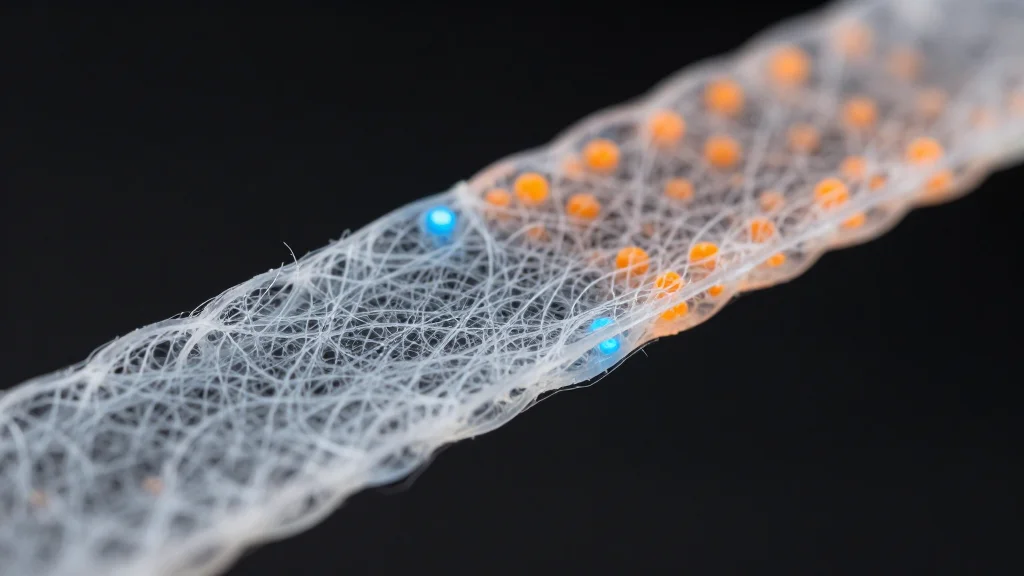
Dual‐Modified Cellulose Nanofiber Membranes with Boosted Surface Charge for High‐Performance Osmotic Energy Conversion
Why It Matters
The breakthrough dramatically lifts the power output of cellulose‑based nanofluidic devices, making osmotic energy a more viable, eco‑friendly renewable source for large‑scale deployment.
Key Takeaways
- •Dual-modified approach combines small-molecule functionalization and polymer grafting.
- •Opposite high surface charges raise power density 12‑14×.
- •Power density reaches 5.1 W/m² (negative) and 4.6 W/m² (positive).
- •Stack of 15 membrane pairs produces 2.5 V, demonstrating scalability.
Pulse Analysis
Osmotic power, harvested from the chemical potential between saltwater and freshwater, has long been hampered by the modest surface charge of nanomaterials, which limits ion selectivity and throughput. Conventional single‑step modifications quickly hit a substitution ceiling, leaving cellulose nanofiber membranes—an attractive low‑cost substrate—far below the performance needed for commercial reverse electrodialysis (RED) systems. Researchers therefore turned to a dual‑modified architecture, pairing a small‑molecule charge enhancer with a polymer graft that preserves channel geometry while dramatically increasing surface charge density.
The combined modification creates two complementary membranes: one densely negative, the other densely positive. This polarity contrast drives highly selective ion transport, achieving a transference number (t⁺) of 0.97 under a 0.5/0.01 M gradient. Power density climbs to 5.1 W·m⁻² for the negative membrane and 4.6 W·m⁻² for the positive counterpart—an order‑of‑magnitude jump over untreated cellulose. When paired in a RED stack, the system delivers 12.9 W·m⁻² at a 5/0.01 M gradient, surpassing most reported cellulose‑based nanofluidic devices and rivaling more expensive synthetic membranes.
Beyond laboratory metrics, the study demonstrates real‑world scalability. A modest assembly of 15 membrane pairs produces a stable 2.5 V output, illustrating that the technology can be scaled without sacrificing efficiency. Because cellulose is abundant, biodegradable, and inexpensive, the dual‑modified membranes promise a sustainable pathway to grid‑scale osmotic power, potentially complementing solar and wind sources in coastal regions where salinity gradients are plentiful. Future work will likely focus on long‑term durability, integration with existing RED modules, and cost‑optimization to accelerate commercial adoption.
Dual‐Modified Cellulose Nanofiber Membranes with Boosted Surface Charge for High‐Performance Osmotic Energy Conversion
Comments
Want to join the conversation?
Loading comments...