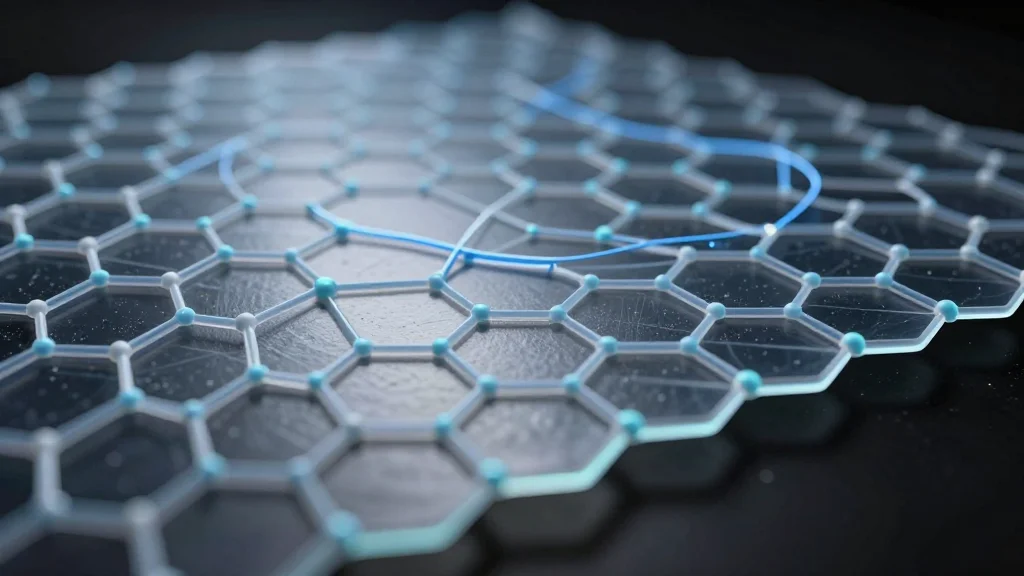
Engineered Magnetic Films Follow Graphene's Equations for Massless Electron Waves
Why It Matters
Linking magnonic crystals to graphene physics provides a predictive framework for designing next‑generation microwave components, accelerating miniaturization in communications infrastructure.
Key Takeaways
- •Hexagonal magnonic crystal mimics graphene's Dirac equations
- •Nine energy bands include massless and topological spin waves
- •Analogy offers clear explanation for complex magnonic behavior
- •Potential to miniaturize microwave circulators dramatically
- •Patent filed for magnonic‑based microwave device concepts
Pulse Analysis
The discovery builds on two decades of graphene research, where electrons behave as massless Dirac fermions, enabling extraordinary electronic properties. By translating that mathematical description to magnonic systems—collective spin excitations in magnetic materials—engineers have opened a new design space where wave‑based information processing can leverage graphene’s well‑understood physics. This cross‑disciplinary bridge reduces the trial‑and‑error traditionally associated with metamaterial engineering, offering a more systematic route to tailor magnetic wave phenomena.
In the experimental implementation, a thin ferromagnetic film was perforated with a honeycomb array of nanoscale holes, creating a magnonic crystal that supports spin‑wave propagation. Computational modeling revealed nine distinct dispersion bands, a richer spectrum than the simple two‑band graphene model. Among these, massless magnonic modes replicate graphene’s linear dispersion, while low‑dispersion and topologically protected bands promise robust, localized excitations. The presence of multiple bands enables simultaneous manipulation of different signal modalities, a feature attractive for multifunctional microwave circuitry.
From a commercial perspective, the ability to emulate graphene’s wave dynamics in a magnetic medium could revolutionize RF component design. Conventional microwave circulators rely on bulky ferrite structures; the newly demonstrated magnonic crystal can be fabricated at micrometer scales, dramatically reducing size and weight. Such compact, low‑loss devices are critical for dense 5G/6G antenna arrays and satellite communications. As the research group pursues patent protection and further integration studies, the industry can anticipate a wave of magnonic‑based components that combine graphene‑inspired performance with the tunability of magnetic materials.
Engineered magnetic films follow graphene's equations for massless electron waves
Comments
Want to join the conversation?
Loading comments...