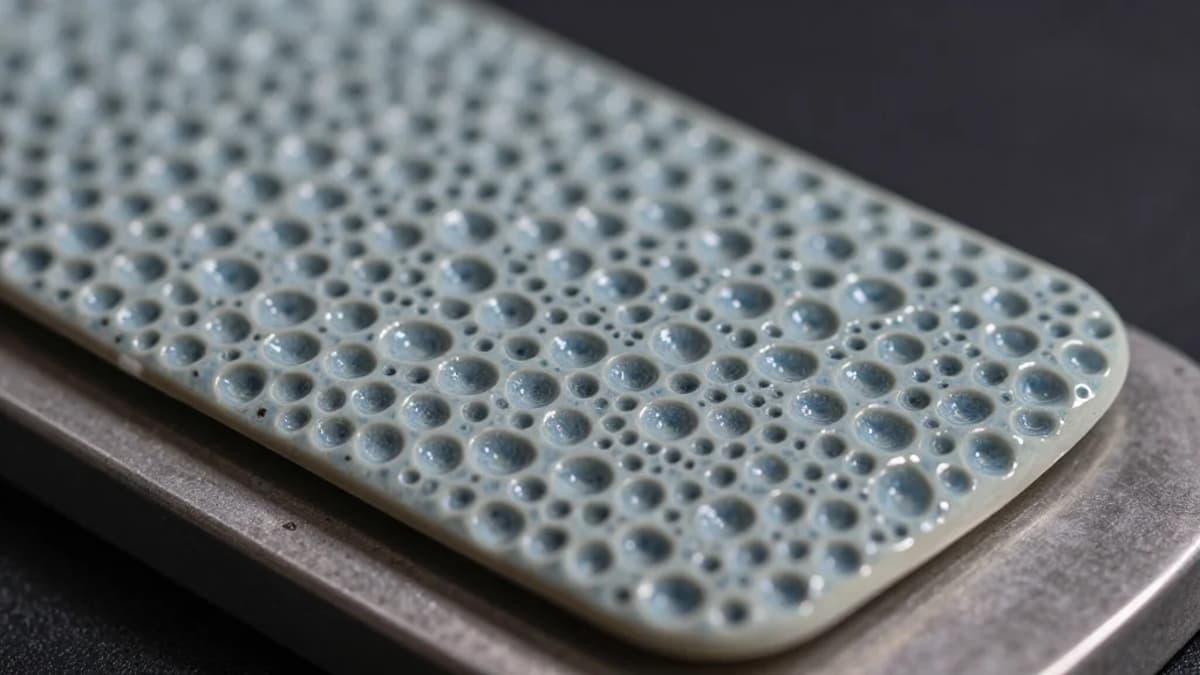
Enhancing Active Surface Area and Gas Diffusion Properties of Low‐Temperature Solid Oxide Fuel Cell Cathodes by Sputtering with Glancing Angle Deposition
•February 3, 2026
0
Companies Mentioned

Why It Matters
The breakthrough dramatically lowers resistance and raises power output of LT‑SOFCs, making compact, efficient clean‑energy generators more viable for commercial and portable applications.
Key Takeaways
- •GLAD yields 21.5% porosity vs 7.5% conventional
- •Polarization resistance drops to 6.4 Ω·cm² at 500 °C
- •Peak power density reaches 836 mW cm⁻² at 550 °C
- •Tunable pressure and thickness control nanocolumnar architecture
- •Enhanced gas diffusion and TPB density boost cathode efficiency
Pulse Analysis
Low‑temperature solid oxide fuel cells promise high efficiency with reduced material costs, yet their cathodes often suffer from limited active surface area and sluggish gas‑phase transport. Conventional sputtering produces dense films that restrict oxygen diffusion, forcing designers to compromise between mechanical stability and electrochemical performance. Glancing angle deposition leverages self‑shadowing to create vertically aligned nanocolumns, dramatically increasing triple‑phase boundary density while preserving structural integrity—key factors for accelerating the oxygen reduction reaction in LT‑SOFCs.
In the reported study, researchers fine‑tuned GLAD parameters, operating at 0.40 Pa sputtering pressure and depositing a 240 nm LSCF layer. This regimen generated a porosity of 21.5%, more than double that of a standard sputtered film, and slashed polarization resistance from 32.9 to 6.4 Ω·cm² at 500 °C. When paired with an anodized aluminum oxide scaffold, a yttria‑stabilized zirconia electrolyte, and a nickel‑yttrium‑doped ceria anode, the cell achieved a record 836 mW cm⁻² at 550 °C. Electrochemical impedance spectroscopy linked the performance boost to improved gas diffusion pathways and a richer triple‑phase boundary network.
The implications extend beyond a single laboratory prototype. By demonstrating that GLAD can reliably engineer nanostructured cathodes with controllable morphology, the work opens a pathway for mass‑manufacturable LT‑SOFC modules that deliver higher power densities at lower operating temperatures. This could accelerate adoption in distributed power systems, portable generators, and hybrid electric vehicles, where compact size and rapid start‑up are critical. Future research will likely explore scaling GLAD to larger substrates, integrating alternative perovskite chemistries, and coupling the technique with additive manufacturing to further streamline production.
Enhancing Active Surface Area and Gas Diffusion Properties of Low‐Temperature Solid Oxide Fuel Cell Cathodes by Sputtering with Glancing Angle Deposition
0
Comments
Want to join the conversation?
Loading comments...