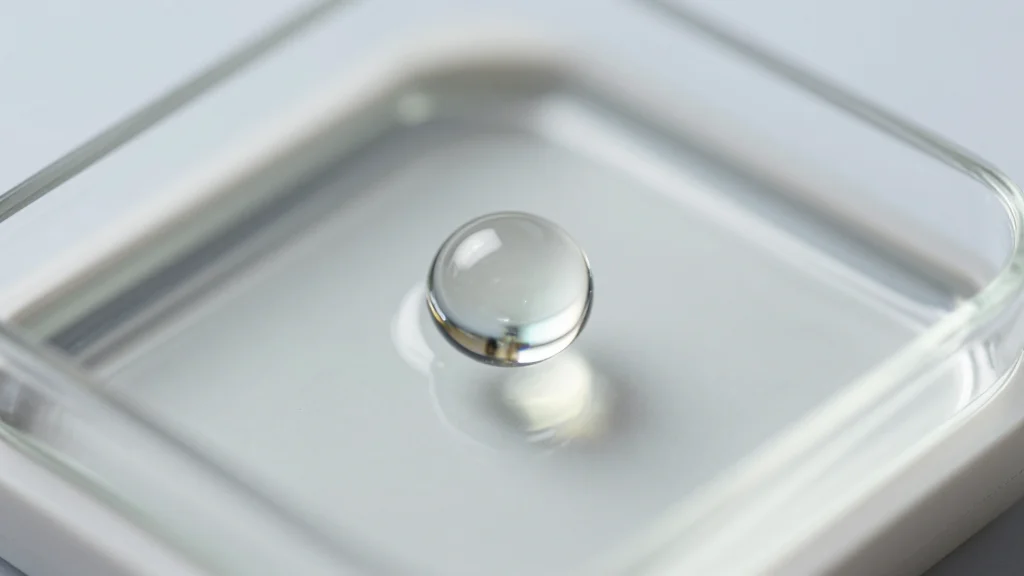
Fluidic‐Enabled Formation of EGaIn Capsules and Droplets With Tunable Surface Chemistry and Electromechanics
Why It Matters
Controlling liquid‑metal morphology and electrical properties removes a major barrier to flexible and reconfigurable electronics, enabling faster adoption in wearables and soft‑robotic systems. The scalable microfluidic method also opens pathways for low‑cost, high‑throughput manufacturing of advanced liquid‑metal devices.
Key Takeaways
- •Acidic ethanol determines oxide-coated capsules vs pure liquid droplets
- •Oxide layer stabilizes shape but causes irreversible plastic deformation
- •Thiol‑PEG click complex prevents coalescence while enabling surface functionalization
- •Capsules act as field‑effect elements; droplets behave as ohmic conductors
Pulse Analysis
Liquid metals such as eutectic gallium‑indium (EGaIn) combine high electrical conductivity with fluidic behavior, making them attractive for soft electronics, stretchable interconnects, and biomedical implants. However, spontaneous oxidation in ambient conditions creates a thin gallium oxide skin that hardens the metal, limiting flow control and device reliability. The new microfluidic technique leverages precise fluid handling to inject EGaIn into an ethanol carrier, where the carrier’s acidity dictates whether an oxide layer forms. This simple chemical knob enables researchers to switch between stable, shape‑locking capsules and highly fluid droplets that can reshape after stress, addressing a longstanding materials challenge.
Beyond oxidation control, the study introduces a thiolated polyethylene glycol (PEG) click complex that self‑assembles at the metal‑liquid interface. This molecular coating acts as a barrier against droplet coalescence while providing reactive sites for further functionalization, such as biomolecule attachment or polymer grafting. Mechanical testing inside the microfluidic device reveals a transition from plastic deformation in oxide‑rich capsules to elastic recovery in PEG‑stabilized droplets, highlighting the platform’s ability to tailor mechanical performance on demand. Electrical measurements confirm that oxide‑coated capsules behave like field‑effect elements, modulating current with applied voltage, whereas the click‑stabilized droplets maintain ohmic conduction, offering designers two distinct circuit components from the same base material.
The implications for industry are significant. Engineers can now fabricate liquid‑metal components with predictable electromechanical characteristics using a scalable, low‑cost microfluidic process, accelerating the development of stretchable displays, soft robotic actuators, and implantable sensors. By integrating shape programmability, surface chemistry, and electrical tuning in a single workflow, the technology bridges the gap between laboratory prototypes and commercial manufacturing, positioning liquid metals as a viable alternative to traditional rigid conductors in next‑generation electronic systems.
Fluidic‐Enabled Formation of EGaIn Capsules and Droplets With Tunable Surface Chemistry and Electromechanics
Comments
Want to join the conversation?
Loading comments...