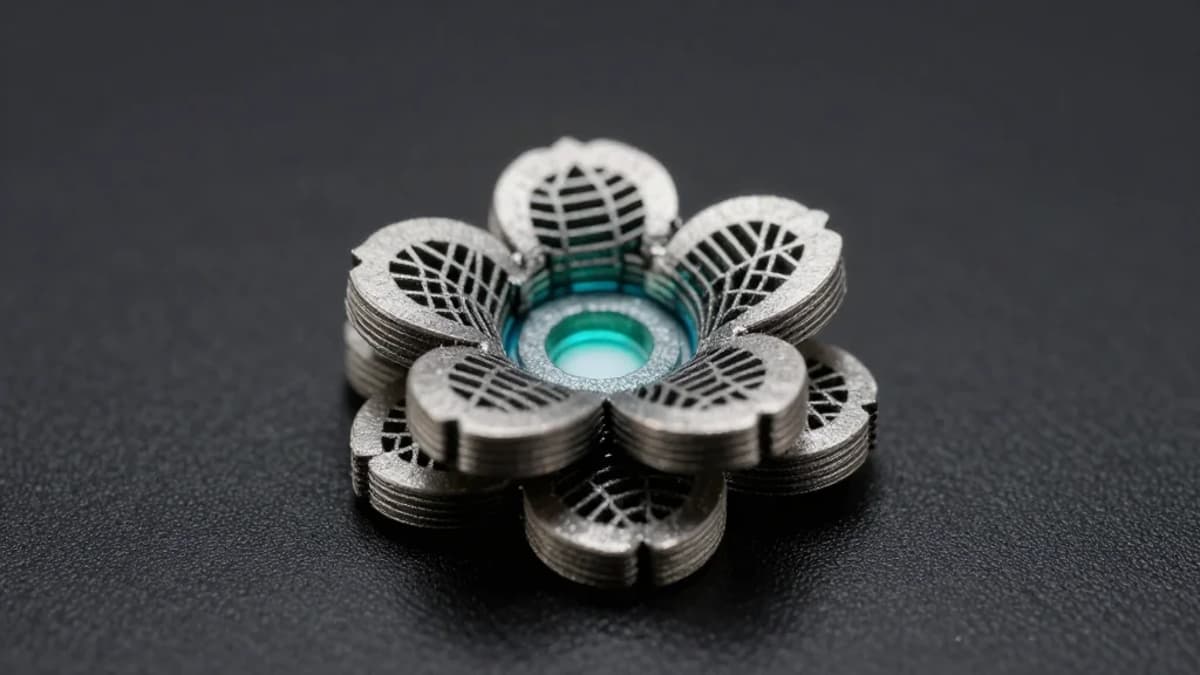
Freestanding 3D MXene Structures Push the Limits of Microscale Devices
•January 29, 2026
0
Why It Matters
By marrying MXene’s material advantages with a scalable, support‑free 3D printing process, the work removes a key bottleneck in miniaturized energy storage, accelerating commercialization of high‑performance microsystems.
Key Takeaways
- •Freestanding 3D MXene printed in single step
- •Additive‑free ink uses aerosol‑jet printing
- •Microsupercapacitor achieves 375 mF cm⁻² capacitance
- •Enables high energy density for wearable microrobots
- •No support structures or post‑processing required
Pulse Analysis
MXenes have been hailed for their exceptional mechanical strength and electrochemical stability, yet translating these two‑dimensional sheets into functional devices has been hampered by architectural constraints. Traditional approaches rely on supporting scaffolds or multi‑step lithography, which add complexity and limit ion transport pathways. The new aerosol‑jet printing (AJP) process sidesteps these hurdles by formulating a pure MXene ink that self‑assembles during droplet evaporation, allowing designers to sculpt fully freestanding three‑dimensional networks in a single deposition. This shift mirrors broader trends in additive manufacturing where material‑level control drives performance gains.
The core of the innovation lies in an additive‑free ink that leverages secondary nanosheet interactions to guide assembly without binders or sacrificial layers. Aerodynamic focusing of micron‑sized aerosol droplets delivers precise placement, enabling the creation of complex geometries such as micro‑flowers and tree‑like forests directly onto substrates. Because the process is mask‑less and operates at ambient conditions, it scales more readily than electron‑beam or focused‑ion‑beam techniques. Moreover, the absence of post‑processing preserves MXene’s intrinsic conductivity and surface chemistry, critical for high‑rate charge storage.
The practical payoff is evident in the demonstrated microsupercapacitor, which outperforms existing high‑resolution devices by delivering an areal capacitance of 375 mF cm⁻² and an energy density of 11.04 µWh cm⁻². Such metrics open doors for ultra‑compact power sources in wearable electronics, autonomous microrobots, and on‑chip energy buffers. As industries push toward ever‑smaller, more efficient components, the ability to print freestanding MXene architectures could become a cornerstone technology, driving both research investment and commercial adoption in the next wave of microscale energy solutions.
Freestanding 3D MXene structures push the limits of microscale devices
0
Comments
Want to join the conversation?
Loading comments...