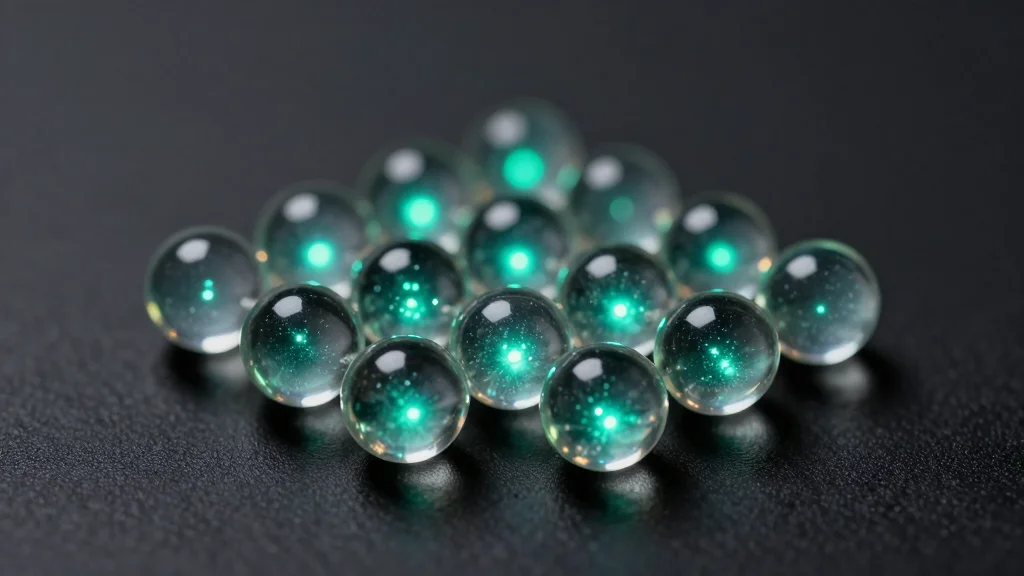
Glass Microspheres Make Perovskite Quantum Dots Tougher for Micro-LED Color Conversion
Key Takeaways
- •Glass microspheres embed perovskite QDs, shielding them from moisture and heat
- •Silver bromide within microspheres supplies bromide ions to heal defect sites
- •Green QD microspheres reach 96.7% PLQY and keep >95% after 10k h water
- •Patterned 20 µm pixel arrays show viable inkjet‑printed micro‑LED color conversion
- •External quantum efficiencies hit 24.8% green and 16.7% red in prototype displays
Pulse Analysis
Micro‑LED technology promises unprecedented brightness and energy efficiency, but its reliance on blue emitters creates a bottleneck for full‑color displays. Conventional phosphor converters struggle with narrow emission spectra and thermal stability, while integrating red and green micro‑LEDs at scale remains costly. Perovskite quantum dots have emerged as a compelling alternative due to their tunable bandgaps and high photoluminescence, yet their sensitivity to moisture, heat, and high‑energy blue photons has limited real‑world deployment. The industry has been searching for a packaging solution that preserves the optical advantages without sacrificing manufacturability.
The newly reported glass‑microsphere approach tackles both external and internal degradation pathways in a single architecture. By growing perovskite QDs inside a submicron silica‑based glass matrix, the particles gain an inorganic barrier that blocks water ingress and moderates temperature spikes. The inclusion of silver bromide acts as an internal bromide reservoir, dynamically repairing halide vacancies that would otherwise trap carriers and reduce efficiency. Importantly, the process—high‑energy ball milling followed by ink‑jet‑compatible photopolymer formulation—produces gram‑scale batches and enables patterning of 20 µm pixel arrays, bridging the gap between laboratory synthesis and panel‑level fabrication.
If the technology scales, it could reshape the display supply chain by eliminating the need for separate red and green micro‑LED chips, simplifying back‑end assembly, and lowering cost per square inch. The reported external quantum efficiencies of 24.8 % (green) and 16.7 % (red) already rival early phosphor converters, while long‑term stability under harsh conditions suggests viable product lifetimes. Remaining hurdles include large‑area uniformity, integration with existing driver electronics, and validation under full thermal‑cycling regimes. Nonetheless, the dual‑protection microsphere concept positions perovskite QDs as a realistic contender for next‑generation high‑definition, ultra‑thin displays.
Glass microspheres make perovskite quantum dots tougher for micro-LED color conversion
Comments
Want to join the conversation?