Graphene-Liquid Metal Sensors Unlock 3D Force Detection for Robots
•March 5, 2026
0
Why It Matters
The sensor provides human‑like tactile perception in a thin, flexible format, unlocking safer, more dexterous manipulation for robotics, prosthetics, and minimally invasive surgery.
Key Takeaways
- •Graphene‑liquid‑metal composite forms anisotropic conductive elastomer.
- •Pyramid microstructures achieve 0.9 μN detection limit.
- •Sensor resolves force direction within 2° accuracy.
- •Enables real‑time 3D tactile feedback for robotic grippers.
- •Patent pending; backed by Royal Society and Henry Royce Institute.
Pulse Analysis
The demand for human‑like touch in robotics has outpaced the capabilities of conventional tactile sensors, which often trade off size, durability, or directional sensitivity. Existing solutions rely on bulky mechanical linkages or complex optical arrays, limiting their integration into compact end‑effectors and wearable prostheses. Cambridge’s new triaxial microsensor array bridges this gap by delivering fingertip‑scale resolution in a thin, flexible format. By simultaneously capturing normal and shear forces, the device opens a pathway to more nuanced manipulation and safer interaction with delicate objects. Such fidelity also reduces the need for external calibration.
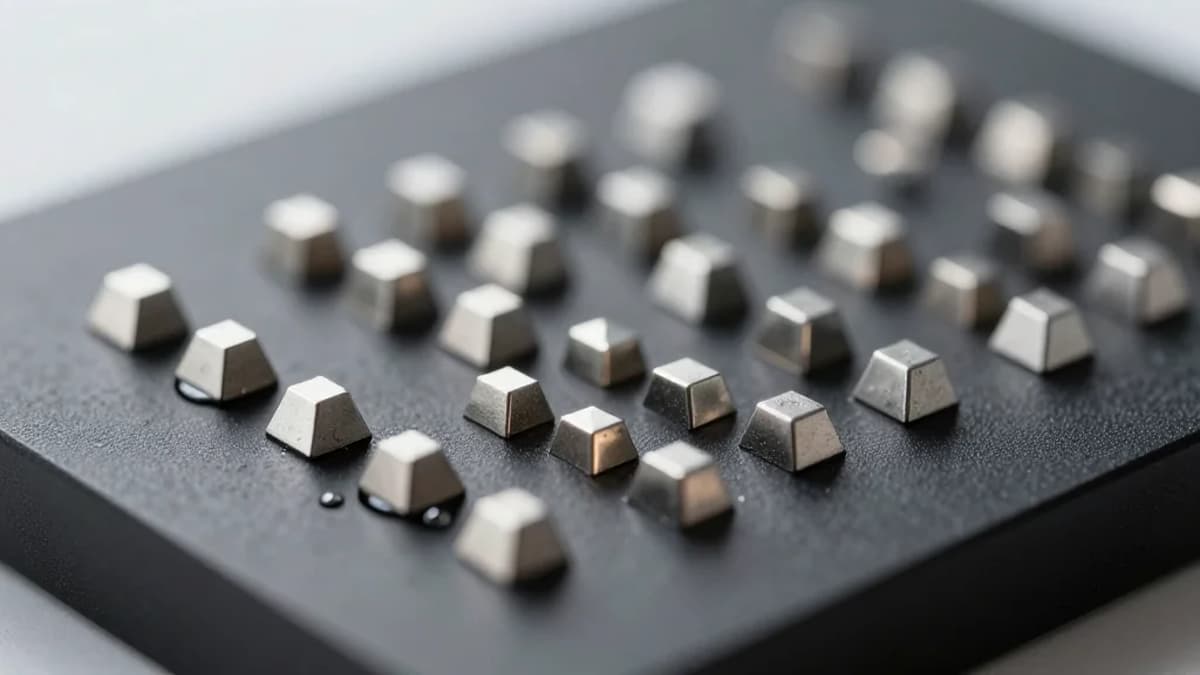
The sensor’s core is an anisotropic porous conductive elastomer (APE) infused with spiky nickel particles, few‑layer graphene sheets, and eutectic gallium‑indium liquid‑metal droplets. Magnetic‑field curing aligns these fillers, creating a solid‑liquid network where liquid‑metal hubs deform elastically while graphene provides stable conductive pathways. Pyramid‑shaped micro‑units as small as 200 µm concentrate stress at their tips, amplifying the electrical response. This architecture yields a sensitivity of 110 kPa⁻¹ across a 500 kPa linear range, a sub‑micronewton detection limit, and less than 2° error in force‑vector reconstruction. The design is compatible with roll‑to‑roll manufacturing, facilitating scale‑up.
Beyond laboratory demos, the array has already been integrated into robotic grippers that autonomously adjust grip force, detect slip, and infer surface roughness without pre‑programmed models. Such capabilities are critical for manufacturing lines handling fragile components, for surgical microrobots navigating tissue, and for next‑generation neuroprosthetic limbs that aim to restore natural touch. With a pending patent and backing from the Royal Society, the Henry Royce Institute, and ARIA, commercialization pathways appear clear, positioning the technology to set new standards in 3‑D tactile sensing across multiple high‑value markets. Early field trials suggest a reduction in error rates by up to 40%.
Graphene-liquid metal sensors unlock 3D force detection for robots
0
Comments
Want to join the conversation?
Loading comments...