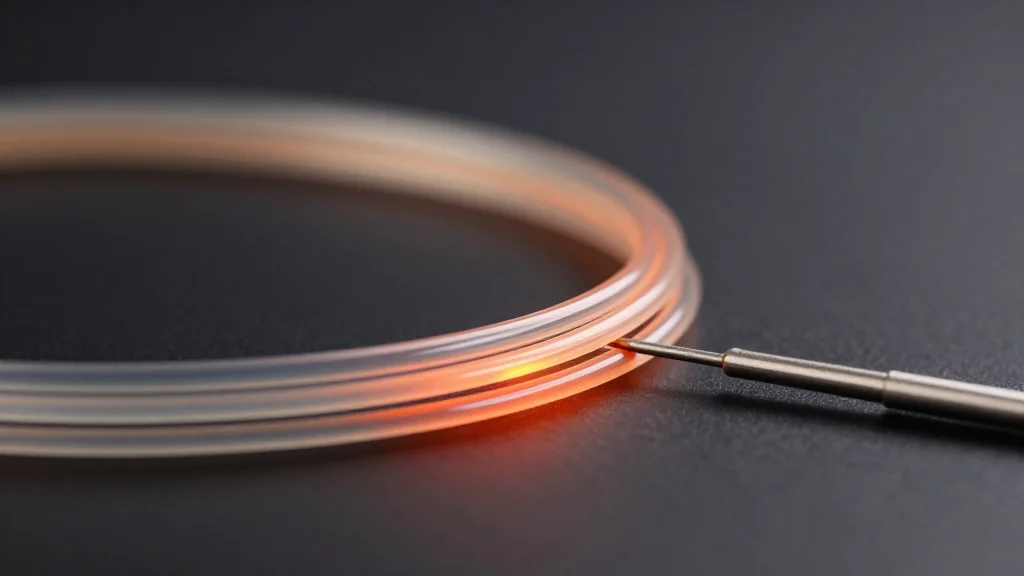
Harvard Engineers Create Shape‑Shifting 3D‑Printed Filaments for Soft Robotics

Why It Matters
The ability to embed programmable actuation within a 3‑D‑printed filament bridges a long‑standing gap between material science and device engineering. Current soft‑robotic platforms rely on external pneumatic or electric actuators, which add bulk and complexity. Harvard’s method offers a monolithic solution where movement is encoded at the material level, potentially reducing manufacturing costs and enabling new form factors for medical devices, adaptive wearables, and responsive infrastructure. Moreover, the research showcases how nanostructured liquid‑crystal elastomers can be integrated into additive manufacturing at scale, a milestone that could spur further investment in nanotech‑enabled printing technologies. As industries seek lighter, more adaptable components, the convergence of nanomaterials and advanced 3‑D printing may become a cornerstone of the next wave of innovation.
Key Takeaways
- •Harvard’s Lewis Lab introduced a rotational multimaterial 3‑D printing process for shape‑shifting filaments
- •Filaments combine an active liquid‑crystal elastomer with a passive elastomer to bend, twist or contract with heat
- •First author Mustafa Abdelrahman highlighted the concept of plugging active materials into the rotating platform
- •Demonstrations include thermally responsive filters, sinusoidal strips, and a pick‑and‑place gripper
- •Next steps focus on lowering activation temperature and testing durability for wearable and soft‑robotic applications
Pulse Analysis
Harvard’s breakthrough arrives at a moment when the soft‑robotics market is transitioning from proof‑of‑concept labs to commercial products. Historically, actuation has been the Achilles’ heel of soft devices; pneumatic chambers and shape‑memory alloys add weight, require bulky control hardware, and suffer from limited lifespans. By embedding actuation directly into the filament’s molecular architecture, the Harvard team sidesteps these constraints, offering a path to truly monolithic soft machines.
The competitive landscape, however, is fragmented. Companies such as Soft Robotics Inc. and researchers at Stanford are pursuing electroactive polymers that respond to voltage rather than temperature, promising faster response times but demanding complex power management. Harvard’s thermally driven approach trades speed for simplicity and energy efficiency, making it attractive for applications where gradual shape change is acceptable—e.g., adaptive wearables that respond to body heat or environmental temperature. The key strategic question will be whether the activation temperature can be tuned low enough to operate safely and comfortably on the human body without external heating.
Looking ahead, the technology’s scalability will determine its market impact. The rotational multimaterial printer is a sophisticated piece of equipment that may be cost‑prohibitive for small‑scale manufacturers. Yet, as the industry standardizes multimaterial extrusion heads, we can expect a cascade of niche suppliers offering turnkey filament kits. If Harvard’s durability data confirm long‑term reliability, the filament could become a foundational component for a new class of soft devices, driving a shift from discrete actuators to material‑level intelligence across nanotech‑enabled manufacturing.
Harvard Engineers Create Shape‑Shifting 3D‑Printed Filaments for Soft Robotics
Comments
Want to join the conversation?
Loading comments...