Heat Breaks the Rules at the Nanoscale and Scientists Used It to Their Advantage
Why It Matters
Controlling heat at the nanoscale could eliminate thermal bottlenecks in next‑generation electronics and boost the efficiency of energy‑conversion technologies, creating a new class of heat‑engineered devices.
Key Takeaways
- •Gold nanostructures quadruple near‑field heat transfer across 100‑nm gaps
- •Resonant coupling with surface phonon polaritons drives the enhancement
- •Enables more efficient cooling for high‑performance microchips
- •Boosts thermophotovoltaic and infrared sensor performance
Pulse Analysis
Near‑field radiative heat transfer (NFRHT) has fascinated physicists for decades because, unlike conventional far‑field radiation, it can exceed the black‑body limit when two surfaces are separated by distances smaller than the thermal wavelength—typically a few hundred nanometers. In this regime, evanescent electromagnetic waves tunnel across the gap, allowing energy to flow at rates orders of magnitude higher than predicted by classical diffusion. While the theory is well‑established, practical demonstrations have been hampered by the difficulty of fabricating structures that can both sustain the tiny separation and manipulate the relevant wave modes.
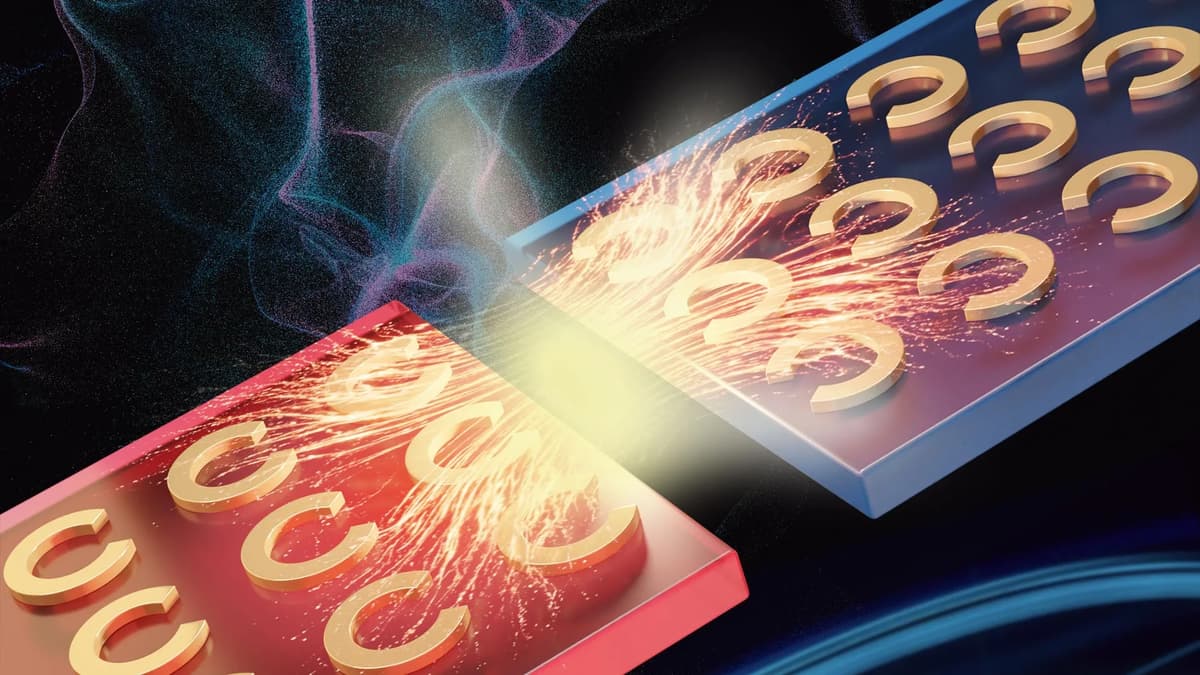
The Carnegie Mellon‑Stanford‑Purdue team solved that problem by patterning microscopic gold resonators onto ultra‑thin membranes and aligning them face‑to‑face across a controlled nanogap. The engineered metamaterial creates a strong resonance with surface phonon polaritons, effectively amplifying the evanescent field and boosting heat flux up to four times the baseline. This experimental validation moves NFRHT from a theoretical curiosity to a designable resource, showing that heat can be steered with the same precision engineers apply to photons or electrons. The approach is compatible with standard micro‑fabrication, suggesting scalability.
The ability to tailor thermal transport at the nanoscale has immediate relevance for the semiconductor industry, where power density continues to outpace traditional cooling solutions. Integrating metamaterial‑enhanced heat spreaders could keep processors within safe operating temperatures while allowing higher clock speeds. Beyond electronics, the same principle can improve thermophotovoltaic generators by increasing radiative coupling between hot emitters and photovoltaic cells, raising overall conversion efficiency. Infrared sensing platforms may also benefit from stronger, more controllable thermal signatures. As funding agencies such as the NSF and the Air Force Office of Scientific Research back further development, commercial prototypes could appear within the next decade.
Heat breaks the rules at the nanoscale and scientists used it to their advantage
Comments
Want to join the conversation?
Loading comments...