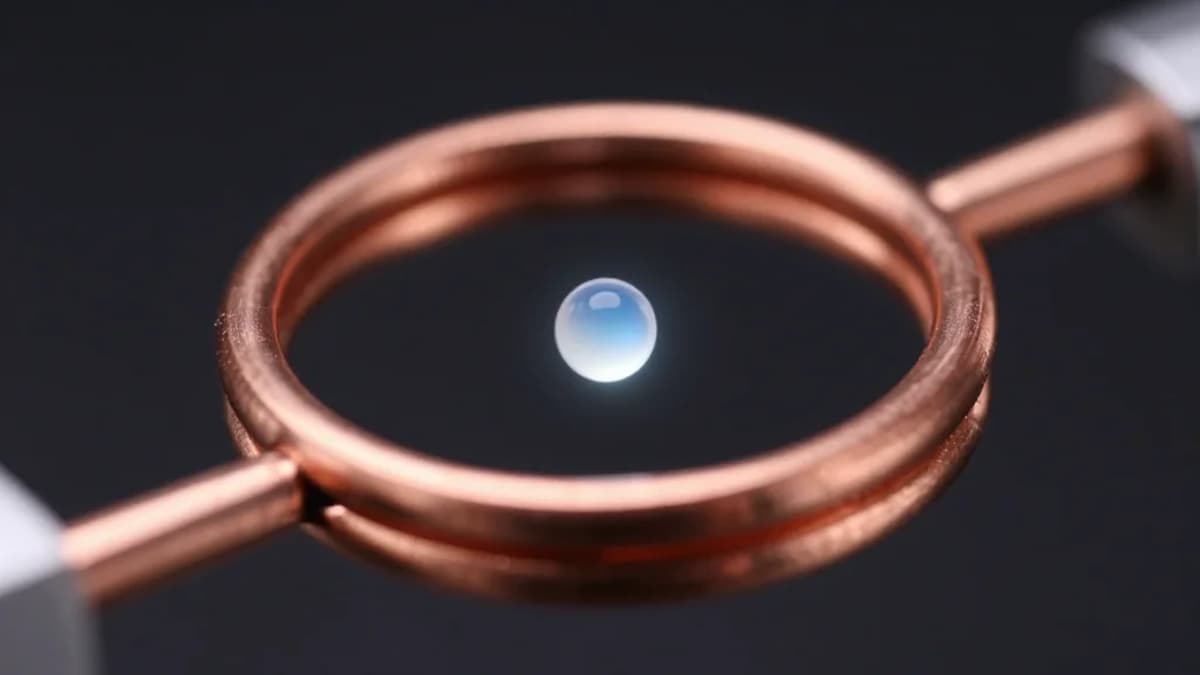
Helium Nanodroplets Trapped for Minutes Unlock New Era in Nanoscale Physics
•February 25, 2026
0
Why It Matters
Extending droplet storage to minute timescales transforms nanoscale experiments, enabling precise calorimetric and spectroscopic studies previously impossible. This advancement could accelerate research in quantum chemistry, astrochemistry, and materials science.
Key Takeaways
- •Stored charged helium droplets for one minute.
- •Extends observation time by 10,000× over prior methods.
- •Enables nanocalorimetry and detailed spectroscopy of embedded molecules.
- •Ion trap technology adapted from exotic nuclei mass measurements.
- •Future plans include in‑trap mass and charge analysis.
Pulse Analysis
Helium nanodroplets have long served as ultra‑cold micro‑laboratories, replicating interstellar conditions for spectroscopic studies of atoms and molecules. Until now, researchers could only observe these droplets for a few milliseconds as they flew from source to detector, limiting the depth of kinetic and thermodynamic measurements. The fleeting window constrained experiments in quantum chemistry and astrochemical modeling, leaving many transient processes uncharted.
The Innsbruck‑Greifswald collaboration overcame this barrier by repurposing a high‑precision ion trap—originally designed for measuring exotic nuclear masses at CERN—to confine charged helium droplets for a full minute. This 10,000‑fold increase in observation time enables researchers to monitor slow energy transfer, chemical reactions, and thermal relaxation within the droplets. Early tests embedding water molecules demonstrated measurable absorption of ambient thermal radiation, a clear indicator of the method’s suitability for nanocalorimetry and high‑resolution spectroscopy. By isolating droplets in ultra‑high vacuum, scientists can now probe subtle quantum effects that were previously drowned out by rapid transit.
Looking ahead, the planned integration of detection cylinders inside the trap will allow real‑time assessment of droplet mass, charge state, and size distribution, turning the system into a comprehensive analytical platform. Such capabilities promise breakthroughs across multiple sectors: quantum materials research can explore low‑temperature phase transitions; astrochemists can simulate interstellar ice chemistry with unprecedented fidelity; and nanomanufacturing may adopt the technique for precise energy‑budget analyses of nanoscale processes. The extended storage paradigm positions helium nanodroplet research at the forefront of interdisciplinary science, opening commercial pathways for advanced metrology and materials design.
Helium nanodroplets trapped for minutes unlock new era in nanoscale physics
0
Comments
Want to join the conversation?
Loading comments...