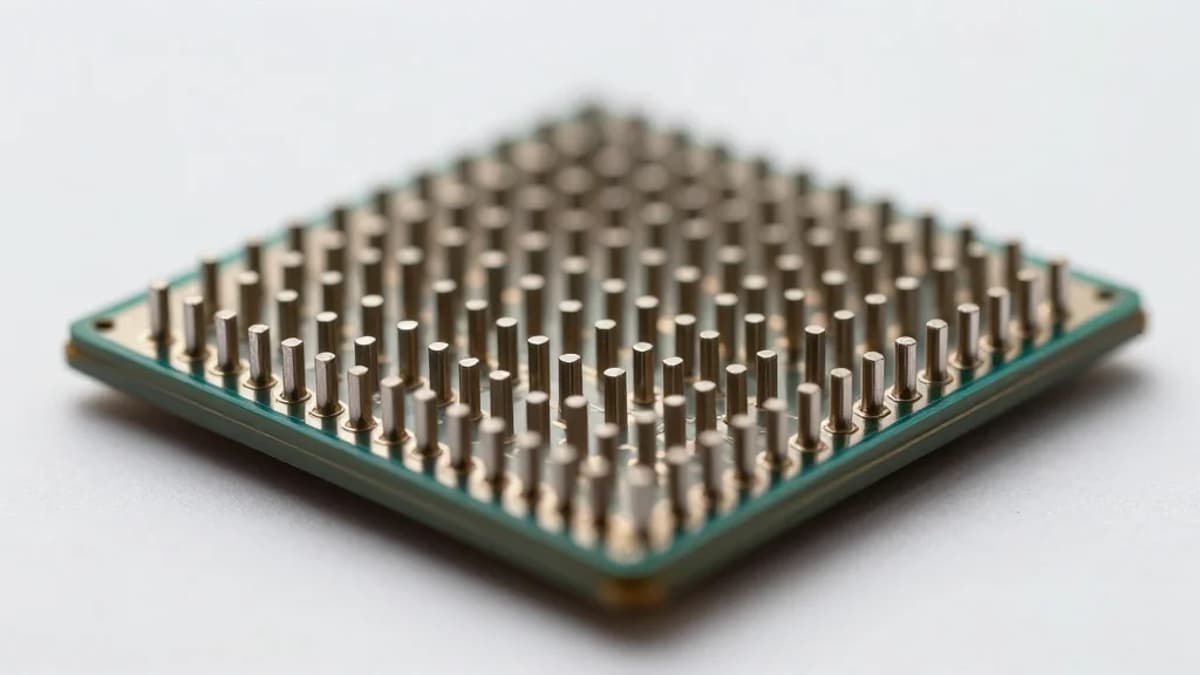
High Perpendicular Anisotropy in Mo‐Inserted Mg Composite Free Layer for Nonvolatile Magnetoresistive Random Access Memory in 4K‐400K Universal Temperature Applications
•January 17, 2026
0
Why It Matters
The breakthrough removes a key temperature‑sensitivity barrier, enabling MRAM to serve demanding automotive, aerospace, and industrial markets where extreme thermal conditions are routine.
Key Takeaways
- •Mo‑doped CoFeB free layer reduces switching voltage drift
- •MgO/MgOx cap stabilizes thermal factor across 4‑400 K
- •VSW sensitivity only 0.68 mV per Kelvin
- •Retention exceeds ten years, error rate below 1 ppm
- •Endurance surpasses 10¹¹ cycles, compatible with BEOL
Pulse Analysis
The rapid expansion of edge‑computing and autonomous systems has intensified demand for memory that can endure harsh thermal environments without sacrificing speed or reliability. Traditional STT‑MRAM excels at scaling and power efficiency, yet its performance degrades when exposed to temperatures far below or above room temperature, limiting its adoption in sectors such as automotive power‑train control or space‑borne instrumentation. Overcoming this limitation requires a material stack that can maintain a stable magnetic anisotropy and low switching voltage across a broad temperature spectrum.
In the new UTF‑NVMRAM architecture, researchers introduced a thin molybdenum interlayer within the CoFeB composite free layer, which acts as a diffusion barrier and enhances perpendicular magnetic anisotropy. Coupled with an engineered MgO/MgOx capping layer, the structure suppresses temperature‑induced variations in both the switching voltage (VSW) and the thermal stability factor (Δ). The resulting VSW sensitivity of 0.68 mV/K and Δ sensitivity of 0.1 K⁻¹ represent a substantial improvement over prior designs, while preserving a high magnetoresistance ratio and enabling back‑end‑of‑line annealing temperatures compatible with standard CMOS processes.
The commercial implications are significant. With ten‑year retention, sub‑1 ppm write error rates, 10 ns write latency, and endurance exceeding 10¹¹ cycles, the technology meets the stringent reliability criteria of automotive electronics, aerospace avionics, and industrial IoT devices that operate from cryogenic to elevated temperatures. Its compatibility with existing 28 nm and smaller process nodes facilitates integration into current manufacturing lines, accelerating time‑to‑market for next‑generation embedded memory solutions. As the ecosystem pushes toward higher reliability under extreme conditions, UTF‑NVMRAM offers a scalable pathway to universal‑temperature nonvolatile storage.
High Perpendicular Anisotropy in Mo‐Inserted Mg Composite Free Layer for Nonvolatile Magnetoresistive Random Access Memory in 4K‐400K Universal Temperature Applications
0
Comments
Want to join the conversation?
Loading comments...