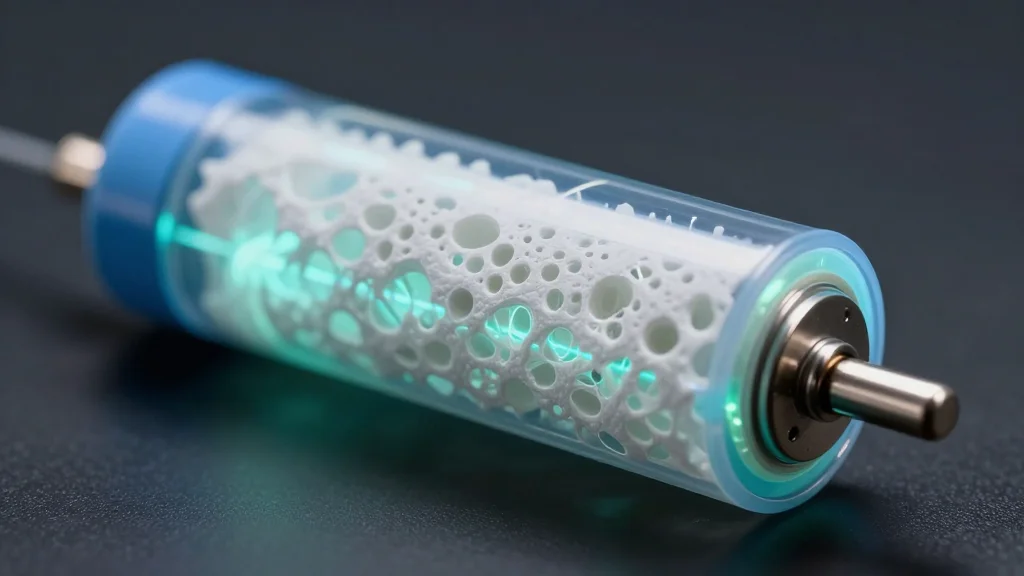
High‐Capacity Lithium‐Sulfur Battery Cathode: Sulfurized Polyacrylonitrile Aerogel Based on Regulation of Aggregated Structure
Why It Matters
The breakthrough tackles the long‑standing volume‑expansion and polysulfide‑shuttle issues that have limited lithium‑sulfur batteries, pushing the technology closer to commercial energy‑storage applications.
Key Takeaways
- •Spray-induced phase inversion creates 3D porous SPAN-A cathode.
- •92.3% capacity retention after 700 cycles at 0.5 C.
- •Initial energy density reaches 791 Wh kg⁻¹ at 0.2 C.
- •Full cell delivers 1,014 mAh g⁻¹ with 94.8% retention.
- •Porous aerogel mitigates volume expansion and polysulfide shuttling.
Pulse Analysis
Lithium‑sulfur (Li‑S) batteries promise energy densities far beyond conventional lithium‑ion cells, yet their commercialization has been hampered by rapid capacity fade caused by polysulfide shuttling and severe volume expansion of the sulfur cathode. Sulfurized polyacrylonitrile (SPAN) emerged as a compelling alternative because its covalent sulfur‑carbon bonds suppress shuttle effects and provide intrinsic electronic conductivity. However, traditional SPAN particles still suffer from structural instability during cycling, limiting practical deployment in high‑energy applications.
The newly reported SPAN‑A aerogel leverages a spray‑induced phase‑inversion process to fabricate an amorphous‑dominated, three‑dimensional porous network. This architecture creates uninterrupted electron pathways and facilitates rapid electrolyte infiltration, while the flexible skeleton absorbs the ~80 % volumetric change that occurs during lithiation and delithiation. Performance data show a remarkable 92.3 % capacity retention after 700 cycles at 0.5 C and an initial energy density of roughly 791 Wh kg⁻¹, figures that rival or exceed many state‑of‑the‑art Li‑S cathodes. In a full‑cell configuration with a prelithiated graphite anode, the system delivers over 1,000 mAh g⁻¹ with 94.8 % retention, underscoring the practical relevance of the microstructural design.
If scalable, this micro‑engineering approach could accelerate Li‑S batteries toward grid‑scale storage and electric‑vehicle markets where high specific energy and long cycle life are paramount. The aerogel method sidesteps the need for expensive protective coatings or complex electrolyte additives, potentially lowering manufacturing costs. Future work will likely explore integration with solid‑state electrolytes and hybrid electrode designs, positioning SPAN‑A as a cornerstone for next‑generation high‑energy storage solutions.
High‐Capacity Lithium‐Sulfur Battery Cathode: Sulfurized Polyacrylonitrile Aerogel Based on Regulation of Aggregated Structure
Comments
Want to join the conversation?
Loading comments...