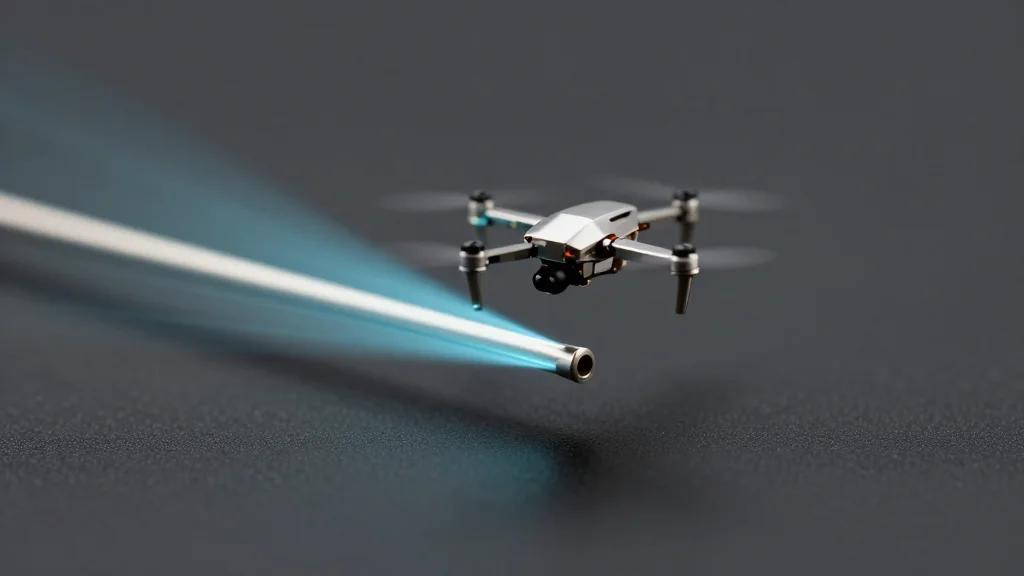
Hokkaido University Unveils Micro‑Drone Platform to Capture Light‑Driven Twisting at the Nanoscale

Why It Matters
The ability to directly measure transverse optical torque at the nanoscale resolves a long‑standing gap in optomechanics, where forces were inferred rather than observed. By confirming that optical helicity, not just angular momentum, can generate torque, the work expands the design space for light‑driven actuation, a cornerstone for nanorobotics, targeted drug delivery, and micro‑fabricated sensors. Moreover, the micro‑drone’s three‑dimensional force mapping provides a universal diagnostic that can accelerate material discovery and device optimization across the nanotech sector. Beyond scientific insight, the technique could catalyze commercial interest in photonic actuation platforms. Companies developing nanorobotic medical tools or ultra‑precise manufacturing processes may adopt the method to validate performance, shortening development cycles and reducing reliance on mechanical components. In a market where optical manipulation tools already command multi‑million‑dollar investments, a breakthrough that adds torque control could unlock new revenue streams and drive competitive differentiation.
Key Takeaways
- •Hokkaido University unveiled a "micro‑drone" platform that measures 3‑D optical forces on nanostructures.
- •The method revealed transverse optical torque—a sideways twisting effect—driven by light helicity.
- •Four laser beams trap a cross‑shaped platform, converting nanoscale forces into measurable motion.
- •Discovery opens pathways for light‑powered nanomachines, advanced sensing, and optomechanical research.
- •Technique may become a standard diagnostic tool for nanophotonics and nanorobotics development.
Pulse Analysis
The micro‑drone breakthrough arrives at a moment when the nanotech industry is seeking non‑contact actuation mechanisms to overcome the scaling limits of traditional micro‑electromechanical systems (MEMS). Historically, optical tweezers have been limited to linear forces and single‑axis rotations, constraining their utility for complex nanorobotic tasks. By delivering a full vector map of optical forces, the Hokkaido team not only validates decades‑old theoretical predictions about helicity‑driven torque but also provides a practical engineering handle.
From a market perspective, the discovery could shift investment toward photonic‑based actuation platforms. Venture capital has already poured over $500 million into companies that integrate light manipulation with nanofabrication, and a tool that quantifies torque in three dimensions reduces technical risk for such ventures. Established players like Nanosys and LightSculptor may accelerate R&D to incorporate helicity control into their product roadmaps, while startups could differentiate by offering turnkey micro‑drone kits for academic and industrial labs.
Looking ahead, the next challenge will be scaling the platform from a laboratory proof‑of‑concept to a manufacturable component. Integration with silicon photonics, on‑chip laser arrays, and real‑time feedback loops could transform the micro‑drone from a measurement device into an active actuator. If successful, we could see the first generation of light‑driven nanorobots capable of navigating complex biological environments or assembling nanoscale circuits, fundamentally altering how we think about motion and control at the molecular level.
Hokkaido University Unveils Micro‑Drone Platform to Capture Light‑Driven Twisting at the Nanoscale
Comments
Want to join the conversation?
Loading comments...