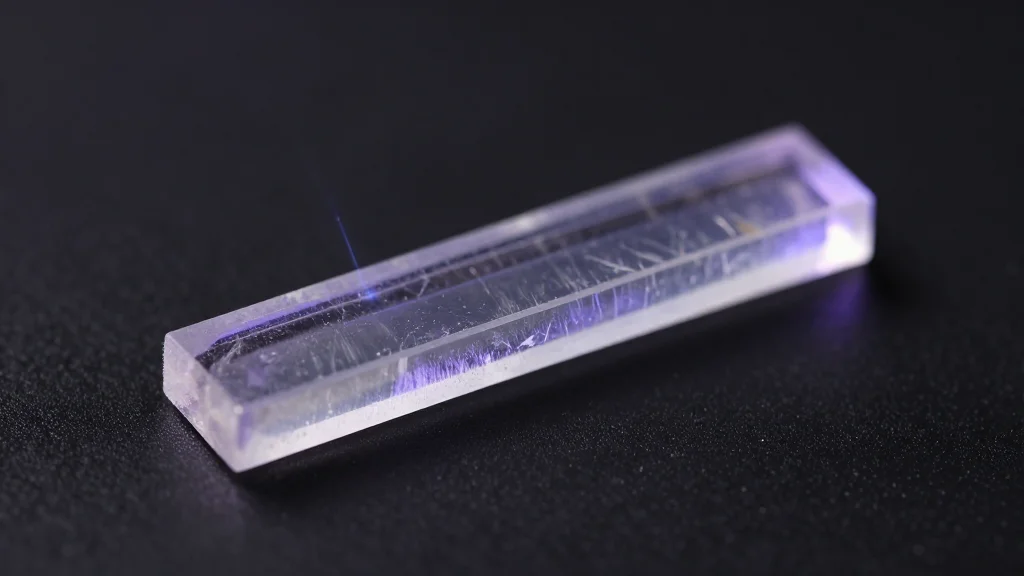
Hybrid MoOCl₂ Crystal Maps Metal‑Glass Duality, Paving Way for Ultra‑Thin AR Lenses

Companies Mentioned
Why It Matters
The ability to engineer a material that toggles between metallic reflection and dielectric transparency at will addresses a long‑standing bottleneck in nanophotonics: the trade‑off between device thickness and optical performance. Ultra‑thin AR lenses could make smart contact lenses and see‑through glasses truly invisible, expanding consumer adoption and opening new medical‑monitoring applications. In data centers and edge‑computing environments, faster, lower‑power photonic chips built on MoOCl₂ could reduce energy consumption and latency, supporting the growing demand for high‑bandwidth processing. Beyond immediate applications, the discovery demonstrates that natural crystals can achieve visible‑light ENZ behavior, a property previously limited to engineered metamaterials operating in the ultraviolet or infrared. This expands the material toolbox for researchers, potentially spurring a wave of innovations in quantum optics, nonlinear photonics, and on‑chip sensing that rely on strong field confinement and slow‑light effects.
Key Takeaways
- •XPANCEO, NUS and Czech researchers map full optical constants of MoOCl₂ for the first time.
- •MoOCl₂ exhibits a visible‑light epsilon‑near‑zero point at 512 nm, intensifying internal electric fields.
- •In‑plane birefringence of ~2.2 enables unprecedented light‑bending in a natural material.
- •Dual metal‑glass behavior could produce AR lenses thousands of times thinner than a human hair.
- •Next 12‑18 months: prototype AR waveguides and photonic chips using MoOCl₂ under development.
Pulse Analysis
MoOCl₂’s emergence as a naturally occurring ENZ material at visible wavelengths is a paradigm shift. Historically, engineers have relied on artificially structured metamaterials—complex, costly, and difficult to scale—to achieve ENZ effects. By leveraging a crystal that already possesses this property, the industry can bypass many fabrication hurdles, potentially lowering the cost curve for high‑performance nanophotonic components. This could accelerate the adoption of AR wearables, which have stalled due to bulk optics and limited field of view.
From a competitive standpoint, XPANCEO’s early‑stage control over MoOCl₂ synthesis positions it as a potential gatekeeper of a new supply chain. If the company can demonstrate reliable, wafer‑scale growth, it may attract strategic partnerships with major optics manufacturers and semiconductor fabs. Conversely, the material’s anisotropic conductivity—behaving as a "bad metal" along one axis—introduces integration challenges, especially under standard CMOS thermal budgets. The upcoming collaboration with foundries will be a litmus test for whether the crystal can survive the rigors of mass production.
Looking ahead, the broader nanotech community will watch how MoOCl₂’s ENZ point is exploited in nonlinear optics and quantum information processing. The ability to slow light and concentrate fields could enhance frequency conversion efficiencies and enable compact on‑chip lasers. If these secondary applications materialize, MoOCl₂ could become a cornerstone material, much like silicon did for electronics, redefining the limits of how thin and fast optical devices can become.
Hybrid MoOCl₂ Crystal Maps Metal‑Glass Duality, Paving Way for Ultra‑Thin AR Lenses
Comments
Want to join the conversation?
Loading comments...