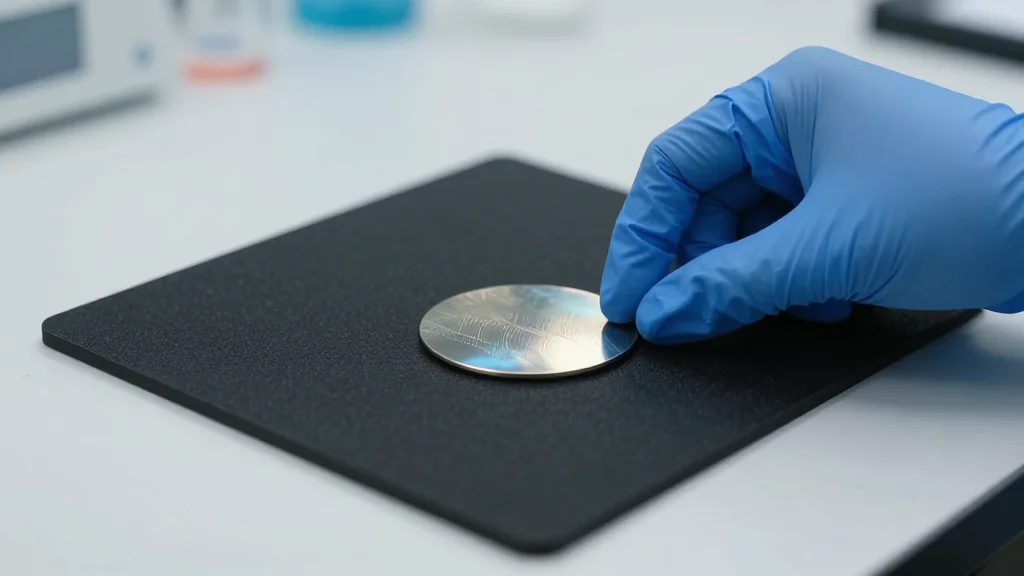
Hydrogen‐Bond Network Redistribution Enables Uniform Ambient‐Air Blade‐Coated Perovskite Solar Modules
Why It Matters
Uniform, ambient‑processed perovskite modules lower production costs and accelerate commercial adoption of next‑generation solar technology.
Key Takeaways
- •TZC additive chelates Pb2+ via bidentate coordination
- •Hydrogen‑bond network shifts from FA‑solvent to TZC complexes
- •Uniform perovskite films achieve 20.3% PCE on 15 cm²
- •75 cm² modules hit 19.4% PCE via blade coating
- •Additive improves moisture resistance and long‑term stability
Pulse Analysis
Scaling perovskite solar cells from laboratory‑scale cells to commercial modules has been hampered by film‑to‑film variability, especially when using the widely adopted DMF‑NMP solvent blend. In this system, strong hydrogen bonds between formamidinium cations (FA⁺) and solvents create localized supersaturation, triggering burst nucleation and uneven crystal growth. The resulting non‑uniform layers limit power‑conversion efficiency and compromise long‑term reliability, making ambient‑air processing a critical bottleneck for cost‑effective manufacturing.
The breakthrough lies in the multifunctional additive 1,2,4‑triazole‑3‑carboxamide (TZC). Its rigid triazole ring and primary amide group form a bidentate chelate with Pb²⁺, outcompeting the weaker monodentate coordination of DMF and NMP. Simultaneously, the amide N‑H groups act as strong hydrogen‑bond donors, engaging halide ions and solvent molecules in direct competition with FA⁺. This redistribution of the hydrogen‑bond network weakens FA⁺ solvation cages, enhances ion mobility, and suppresses local concentration gradients, leading to controlled nucleation and uniform crystal growth across large substrates.
The practical impact is evident: blade‑coated perovskite modules processed in ambient air achieve 20.3% efficiency on a 15 cm² area and 19.4% on a 75 cm² panel—record figures for non‑vacuum fabrication. Moreover, TZC‑treated films exhibit superior moisture tolerance and retain performance over extended aging tests. By delivering high efficiency, scalability, and durability without glove‑box conditions, this approach could dramatically reduce capital expenditures for perovskite manufacturing, positioning the technology as a viable competitor to silicon in the near‑term renewable market.
Hydrogen‐Bond Network Redistribution Enables Uniform Ambient‐Air Blade‐Coated Perovskite Solar Modules
Comments
Want to join the conversation?
Loading comments...