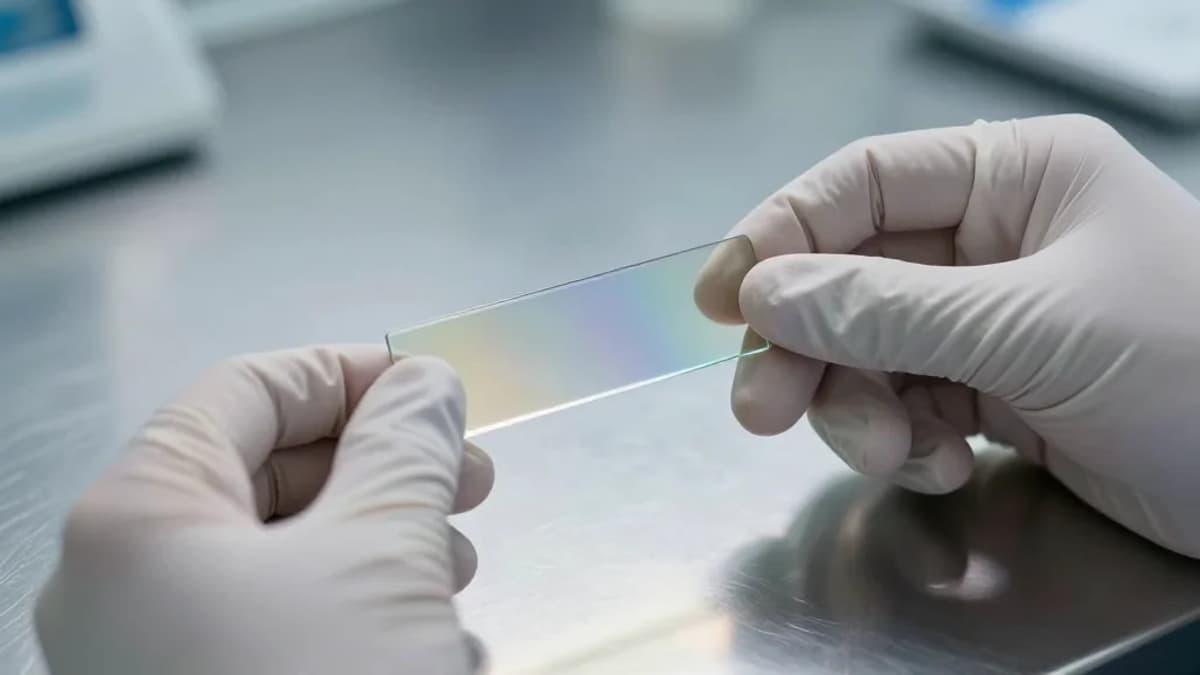
Immiscible Binary Organic Phase‐Change Composites with Segregated H‐BN Networks for Advanced Thermal Management (Small 13/2026)
•March 3, 2026
0
Why It Matters
The breakthrough provides a low‑cost, high‑performance thermal interface material that can be integrated into electronic cooling systems, addressing the growing heat‑dissipation challenges of high‑density processors.
Key Takeaways
- •Segregated h‑BN network yields 20 W m⁻¹ K⁻¹ conductivity.
- •Composite remains shape‑stable above phase‑change temperature.
- •Melt‑mixing enables reprocessable adhesion for electronics.
- •Latent heat can be tuned for specific cooling loads.
- •Process uses particle‑stabilized emulsification, no complex fabrication.
Pulse Analysis
The relentless scaling of semiconductor chips has intensified the demand for thermal interface materials that can move heat away from hotspots faster than ever before. Conventional metal‑based greases offer high conductivity but suffer from leakage, limited reworkability, and incompatibility with delicate components. Organic phase‑change materials (PCMs) provide latent‑heat buffering, smoothing temperature spikes, yet their intrinsic thermal conductivity is often too low for modern CPUs. Bridging this gap requires a hybrid solution that combines the high conductivity of inorganic fillers with the adaptive properties of organic matrices, without resorting to complex manufacturing.
The study by Lee and Kim introduces an immiscible binary organic PCM that spontaneously forms a segregated network of hexagonal boron nitride (h‑BN) through particle‑stabilized emulsification. By melt‑mixing the components, the h‑BN platelets align into continuous pathways, delivering a measured thermal conductivity of 20 W m⁻¹ K⁻¹—comparable to many metal‑based TIMs. Simultaneously, the organic matrix retains shape stability above its melting point and can be re‑processed, allowing the composite to adhere to surfaces and be reclaimed after service. Latent‑heat capacity is tunable by adjusting the organic phase ratio, giving designers flexibility to match specific cooling loads.
From a commercial perspective, this technology promises a cost‑effective, scalable thermal management solution for data centers, high‑performance computing, and emerging edge devices. The simple emulsification and melt‑mixing steps are compatible with existing polymer processing lines, reducing barriers to mass production. Moreover, the reprocessable nature of the composite aligns with sustainability goals, enabling component refurbishment and waste reduction. Future work may explore alternative filler geometries, integration with heat spreaders, or embedding sensors for real‑time thermal monitoring, positioning the material as a versatile platform in the next generation of thermal interface engineering.
Immiscible Binary Organic Phase‐Change Composites with Segregated h‐BN Networks for Advanced Thermal Management (Small 13/2026)
0
Comments
Want to join the conversation?
Loading comments...