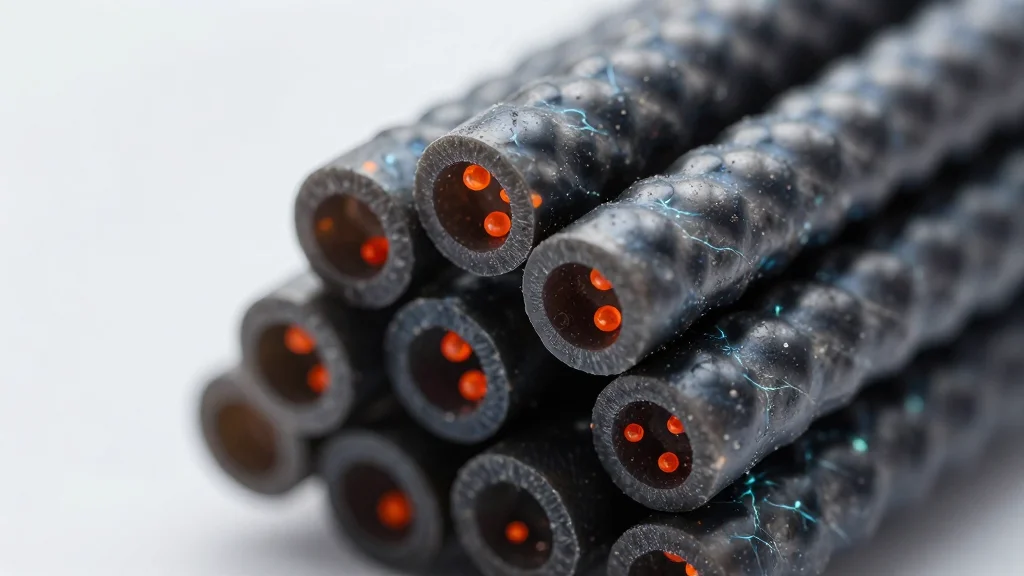
Interfacial Nano‐Pitting and In Situ Sulfate‐Directed Growth of Na2.85V2(PO4)2.85(SO4)0.15 Nanodots on MWCNT for Ultrafast Sodium‐Ion Storage
Why It Matters
The advance provides a cost‑effective sodium‑ion platform that couples high energy with ultra‑high power, addressing lithium scarcity and fast‑charging demands for grid storage and electric vehicles.
Key Takeaways
- •Ultracentrifugation creates ~5 nm pits on carbon nanotubes for nanodot nucleation
- •Sulfate ions act both as etchant and crystal precursor in NVPS formation
- •NVPS/MWCNT delivers 97 mAh g⁻¹ at 1000C, 3.6 s full charge‑discharge
- •Strong nanodot‑carbon coupling shortens electron and sodium‑ion pathways
- •Scalable method bridges battery‑type energy and capacitor‑type power
Pulse Analysis
Sodium‑ion technology is gaining traction as a lower‑cost alternative to lithium, but achieving both high energy density and rapid power delivery remains a technical hurdle. Conventional sodium‑ion electrodes often sacrifice rate capability for capacity, limiting their suitability for applications that demand quick charge‑discharge cycles such as grid‑balancing or fast‑charging electric vehicles. Researchers therefore seek nanostructured designs that shorten ion diffusion paths while preserving electronic conductivity.
The new approach leverages a phosphate‑sulfate ultracentrifugation pretreatment to etch nano‑pits roughly 5 nm deep into multi‑walled carbon nanotubes. These pits act as confined nucleation cavities where Na2.85V2(PO4)2.85(SO4)0.15 nanodots crystallize in situ, with sulfate ions simultaneously guiding crystal growth and reinforcing the carbon matrix. The resulting nanodot‑carbon hybrid exhibits a tightly coupled interface that minimizes resistance for both electrons and sodium ions, enabling a full charge‑discharge in just 3.6 seconds at an extreme 1000C rate while retaining 83 % of theoretical capacity.
Beyond the laboratory, this sulfate‑directed nano‑pitting strategy offers a scalable pathway to produce high‑density nanodot/carbon composites using existing ultracentrifugation infrastructure. By bridging the performance gap between batteries and supercapacitors, the technology could accelerate the rollout of fast‑charging, long‑life sodium‑ion storage systems for renewable‑energy integration and next‑generation electric mobility. Continued optimization of pit density and nanodot composition may further push energy and power metrics, positioning sodium‑ion devices as a viable, cost‑effective complement to lithium‑based solutions.
Interfacial Nano‐Pitting and In Situ Sulfate‐Directed Growth of Na2.85V2(PO4)2.85(SO4)0.15 Nanodots on MWCNT for Ultrafast Sodium‐Ion Storage
Comments
Want to join the conversation?
Loading comments...