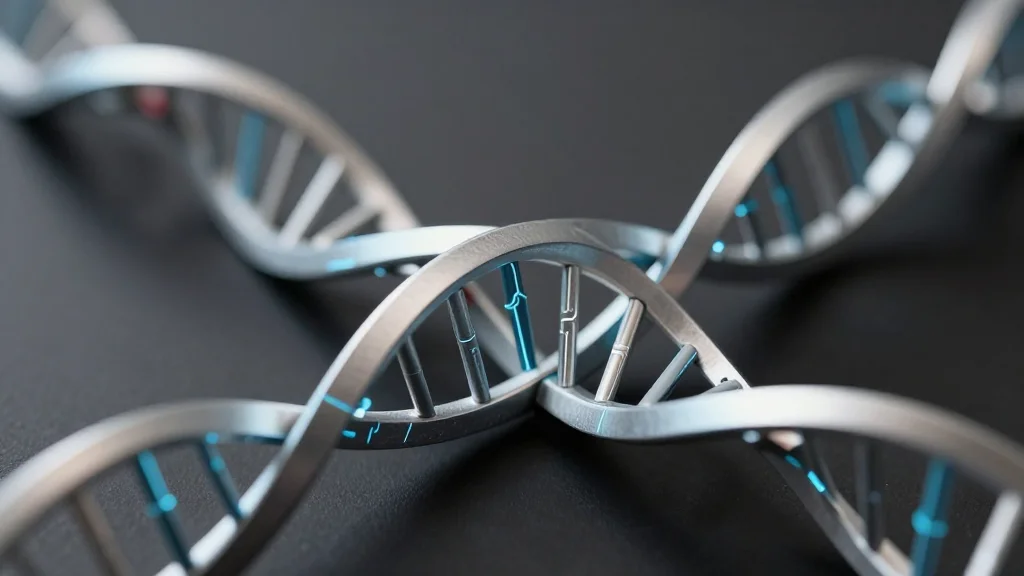
KAIST DNA Computer Merges Memory and Logic Below 2 Nm

Why It Matters
The KAIST DNA computer demonstrates that biological molecules can perform functions traditionally reserved for silicon, challenging the notion that semiconductor scaling is the sole path to higher performance. By integrating memory and logic at sub‑2 nm dimensions, the technology promises unprecedented data‑density and energy efficiency, which are critical for emerging applications such as edge AI, implantable health monitors, and next‑generation data centers. Moreover, the reusable nature of the circuit addresses a long‑standing limitation of DNA computing—its single‑use characteristic—making it a more practical foundation for scalable bio‑electronics. Beyond technical metrics, the work signals a strategic pivot for the nanotech industry. As physical limits curb traditional transistor miniaturization, investors and corporations are increasingly funding alternative computing paradigms, including quantum, photonic, and molecular approaches. KAIST’s success could accelerate funding flows into bio‑nanotech startups and stimulate partnerships between academic labs and commercial entities seeking to diversify their technology portfolios.
Key Takeaways
- •KAIST team led by Prof. Yeongjae Choi created a DNA bio‑transistor that merges processing and storage.
- •Circuit operates at sub‑2 nm scale, comparable to the smallest silicon nodes.
- •DNA configuration can be reset, enabling reusable computation unlike prior one‑time DNA circuits.
- •Potential for ultra‑dense data storage—petabyte‑scale information in microscopic volumes.
- •Next research phase aims to build larger networks and demonstrate practical computational tasks.
Pulse Analysis
The KAIST breakthrough arrives at a crossroads where the semiconductor industry is confronting the physical ceiling of Moore’s Law. Historically, each new node has delivered roughly a 30% performance boost, but as transistors shrink below 2 nm, quantum tunneling and heat dissipation become prohibitive. Molecular computing, especially DNA‑based, offers a fundamentally different scaling law: information density is dictated by the 0.34 nm spacing of nucleotides, not by lithographic limits. This shift could reset the performance curve, delivering orders of magnitude more bits per unit area with negligible power draw.
From a market perspective, the immediate commercial impact may be modest; the technology is still at a proof‑of‑concept stage. However, the strategic implications are profound. Companies that have built expertise in synthetic biology—such as Twist Bioscience, Ginkgo Bioworks, and DNA‑storage startups like Catalog—could leverage this architecture to expand into computing, creating a new vertical that blends data storage with biosensing. Meanwhile, traditional chipmakers may explore hybrid integration, embedding DNA layers onto silicon wafers to offload specific low‑power tasks.
Looking ahead, the key challenge will be manufacturing reproducibility and error correction. DNA reactions are stochastic, and scaling from a single bio‑transistor to a functional processor will demand robust error‑mitigation schemes. If the KAIST team can demonstrate reliable multi‑gate operation, it could catalyze a wave of investment similar to the early days of silicon photonics. In the longer term, the convergence of bio‑nanotech and computing could redefine the hardware stack for applications where size, power, and biocompatibility are paramount, from implantable diagnostics to autonomous environmental sensors.
KAIST DNA Computer Merges Memory and Logic Below 2 nm
Comments
Want to join the conversation?
Loading comments...