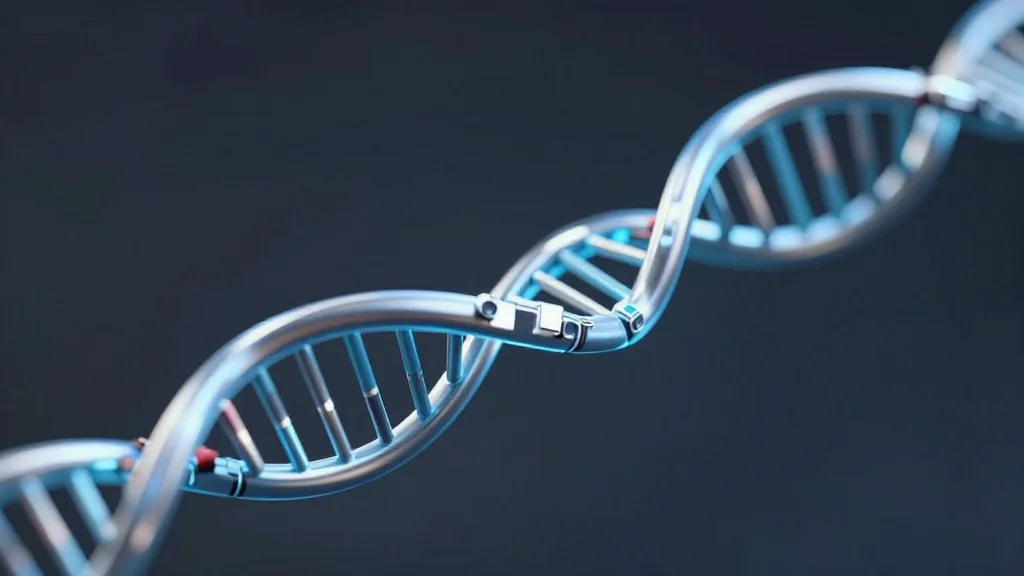
KAIST Unveils DNA Bio‑Transistor at 2‑nm Scale, Pioneering Reusable Molecular Computing

Why It Matters
The 2‑nm DNA bio‑transistor demonstrates that molecular systems can rival, and potentially surpass, silicon in feature density while offering intrinsic biocompatibility. This opens a pathway for computing platforms that operate directly within biological environments, reducing the need for external hardware in point‑of‑care diagnostics and environmental monitoring. Beyond healthcare, the technology challenges the prevailing narrative that Moore’s Law is ending. By shifting the substrate from silicon to DNA, researchers can sidestep the physical constraints that have slowed transistor scaling for years, potentially revitalizing growth in high‑performance computing and data‑intensive AI workloads.
Key Takeaways
- •KAIST team led by Prof. Yeongjae Choi built a DNA bio‑transistor with 2‑nm feature size
- •First molecular circuit to combine computation and memory without external reset
- •Overcomes the one‑time‑use limitation of prior DNA logic gates
- •Potential to enable ultra‑dense, low‑power processors for medical diagnostics
- •Research announced on April 22; peer‑reviewed publication pending
Pulse Analysis
The KAIST breakthrough arrives at a critical inflection point for the semiconductor industry. As silicon transistors inch toward the 2‑nm barrier, power leakage and fabrication complexity have surged, prompting a search for fundamentally different computing substrates. DNA, with its predictable base‑pairing and sub‑nanometer spacing, offers a compelling alternative, but practical implementations have lagged due to irreversibility and lack of memory.
By engineering reversible binding configurations, the KAIST team not only solves the irreversibility problem but also demonstrates a functional analogue of a transistor—a component that can both receive a signal and store its state. This dual capability mirrors the logic‑memory convergence seen in emerging neuromorphic chips, yet it does so at a scale orders of magnitude smaller. If the speed and error rates can be brought to parity with electronic devices, DNA‑based processors could carve out niches where power consumption and biocompatibility are paramount, such as implantable sensors or lab‑on‑a‑chip platforms.
However, significant hurdles remain. Molecular reactions are inherently slower than electron flow, and integrating DNA circuits with existing electronic infrastructure will require novel interfacing technologies. Moreover, large‑scale manufacturing of reliable DNA components poses supply‑chain and standardization challenges. Investors and policymakers should monitor how quickly the research moves from proof‑of‑concept to scalable fabrication, as early adopters could secure a strategic advantage in the emerging bio‑computing market.
KAIST Unveils DNA Bio‑Transistor at 2‑nm Scale, Pioneering Reusable Molecular Computing
Comments
Want to join the conversation?
Loading comments...