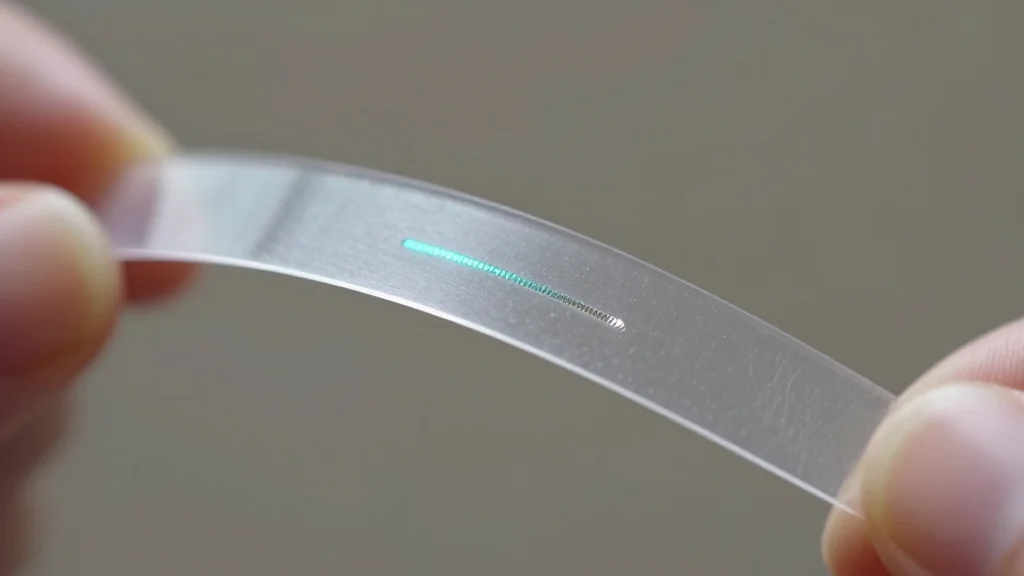
Korean Researchers Unveil Ultrathin Optical Transducer That Triples Light Output When Bent

Why It Matters
The transducer demonstrates that nanometer‑scale engineering can overturn the conventional trade‑off between flexibility and optical efficiency, a hurdle that has limited the deployment of photonic components in wearable form factors. By delivering a mechanically tunable light source, the technology could enable new diagnostic tools that monitor health metrics without electrical contacts, reducing skin irritation and improving data fidelity. Beyond health monitoring, the principle of strain‑induced plasmonic enhancement may be applied to flexible displays, adaptive camouflage, and soft‑robotic vision systems. The breakthrough also showcases the strategic value of university‑industry collaborations in South Korea, positioning the region as a leader in nanophotonic research and potentially attracting global partnerships.
Key Takeaways
- •UNIST and Ajou University researchers created a flexible optical transducer that triples SHG signal at 1.2% compressive strain.
- •Device uses a 20‑nm metallic nanogap and a monolayer of MoS₂ on a flexible substrate.
- •Performance remains stable after 190 bending cycles, indicating durability for wearables.
- •Published in Science Advances on May 8, 2026, marking the first demonstration of strain‑enhanced second‑harmonic generation in a flexible platform.
- •Potential applications include wearable optical sensors, soft‑robotic vision, and flexible photonic circuits.
Pulse Analysis
The Korean team's nanogap‑based transducer arrives at a moment when the flexible electronics sector is seeking differentiation beyond conventional stretchable conductors. Historically, photonic components have lagged because bulk crystals and waveguides cannot be thinned without sacrificing confinement. By leveraging a 2‑D semiconductor and a sub‑20‑nm plasmonic gap, the researchers have effectively created a ‘mechanical gain’ mechanism that could be layered onto existing flexible circuit stacks.
From a market perspective, the ability to generate a measurable optical output from minute mechanical deformations could disrupt current strain‑sensor ecosystems dominated by piezoresistive and piezoelectric technologies. Optical readouts are inherently immune to electromagnetic noise, a critical advantage for medical environments and industrial IoT deployments. If the team can integrate low‑power photodetectors and wireless communication, the solution could undercut the cost and complexity of current wearable sensor modules.
Looking ahead, the primary challenge will be scaling the nanogap fabrication from laboratory‑scale electron‑beam lithography to roll‑to‑roll processes compatible with mass production. Success in that arena would not only validate the technology for commercial use but also set a new benchmark for nanophotonic manufacturing. Investors and corporate R&D groups should monitor the upcoming prototype demonstrations, as they will likely dictate the speed at which this capability moves from academic paper to market‑ready product.
Korean Researchers Unveil Ultrathin Optical Transducer That Triples Light Output When Bent
Comments
Want to join the conversation?
Loading comments...