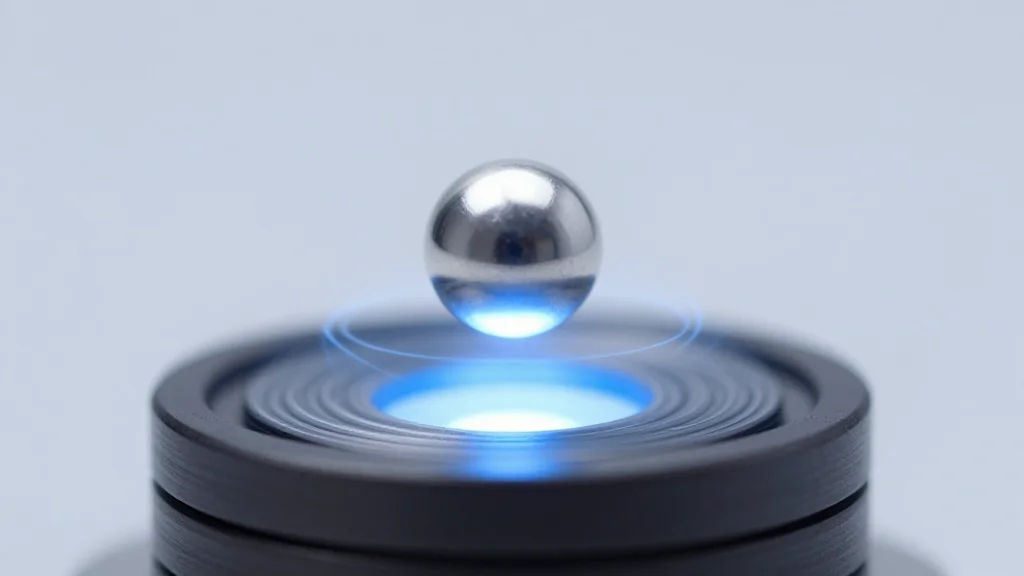
Levitated Nano-Ferromagnet Confirms a 160-Year-Old Physical Prediction
Why It Matters
The work validates a long‑standing theoretical concept and opens pathways for magnetic sensors that could outperform existing atomic magnetometers, accelerating advances in quantum sensing and precision measurement.
Key Takeaways
- •40 µm ferromagnetic sphere levitated via Meissner effect.
- •First experimental confirmation of Maxwell’s 1860s gyroscopic prediction.
- •Gyroscopic coupling enables ultrasensitive magnetic field sensors surpassing atomic magnetometers.
- •Miniaturized chip‑scale traps could bring quantum sensing to commercial scale.
- •Findings may aid tests of general relativity and quantum‑classical boundary studies.
Pulse Analysis
Maxwell’s 1860s speculation that a static ferromagnet could behave like a gyroscope remained untested for more than a century. The breakthrough came when a team led by Andrea Vinante suspended a 40‑micron neodymium sphere inside a superconducting cavity, exploiting the Meissner effect to achieve frictionless levitation. Precise SQUID readouts revealed an unexpected elliptical wobble, confirming that internal electron‑spin alignment imparts a hidden angular momentum that mimics the precession of a spinning top. This experimental validation not only settles a historic physics question but also showcases the power of nanoscale control in condensed‑matter systems.
The observed gyroscopic coupling translates directly into sensor technology. By monitoring the precession of the levitated magnet in an external field, researchers can detect magnetic variations with sensitivity that could exceed that of atomic magnetometers, whose performance is limited by quantum projection noise. The ferromagnetic gyroscope operates without the need for laser cooling or complex atomic ensembles, offering a potentially simpler, more robust platform for ultra‑low‑noise magnetometry. Such sensors could be pivotal for biomedical imaging, geophysical exploration, and navigation systems that demand nanotesla‑level precision.
Looking ahead, the team aims to shrink the apparatus onto a microfabricated chip, enabling arrays of nanomagnets to be levitated and interrogated simultaneously. This miniaturization would amplify the gyroscopic effect, making it dominant at even smaller scales and opening doors to hybrid quantum devices that bridge classical mechanics and quantum coherence. Beyond sensing, the technology could support tests of general relativity, investigations of quantum decoherence, and the development of levitated‑nanomagnet quantum bits, positioning ferromagnetic gyroscopes at the frontier of next‑generation quantum engineering.
Levitated nano-ferromagnet confirms a 160-year-old physical prediction
Comments
Want to join the conversation?
Loading comments...