Light-Switchable Molecules Could Tune Spin Waves in 2D Magnets
Key Takeaways
- •Light‑switchable Fe‑pz molecules strain CrSBr to tune magnon bandgaps
- •20‑period molecular stripes achieve >90% reflectivity at selected energies
- •Low‑spin to high‑spin transition changes reflectivity from 70% to 1% at 75 µeV
- •Dense molecular packing reduces charge transfer, preserving spin‑crossover behavior
- •Proposed approach enables reprogrammable nanoscale magnonic filters without bulky hardware
Pulse Analysis
The rapid growth of magnonic computing hinges on the ability to shape spin‑wave spectra with nanometer precision. Conventional reconfigurable magnonic crystals rely on lithographed magnetic domains, current‑carrying wires, or bulk strain actuators, all of which extend well beyond the sub‑100 nm wavelengths of modern magnons and introduce excessive damping. As a result, device footprints become large and energy‑inefficient, limiting integration with CMOS‑compatible platforms. Researchers therefore seek a chemical or optical lever that can modulate magnetic properties locally, without the overhead of macroscopic hardware.
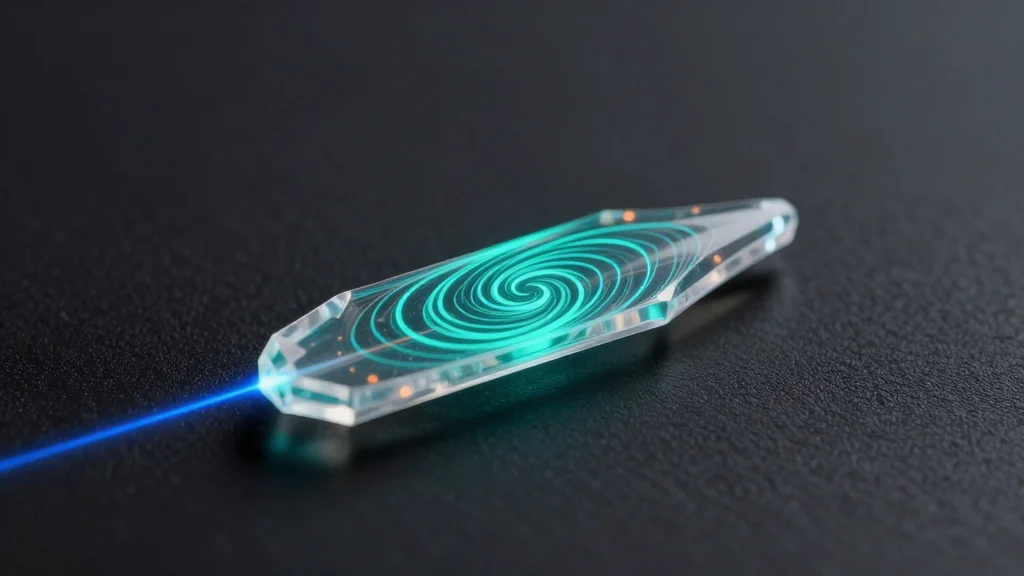
The recent *Advanced Materials* study proposes a heterostructure of atomically thin CrSBr topped with the spin‑crossover molecule Fe‑pz as a light‑driven actuator. When illuminated, Fe‑pz switches from a low‑spin to a high‑spin state, expanding by roughly 1.3 % and exerting strain on the underlying CrSBr lattice. This strain selectively alters exchange pathways along the crystal’s b‑axis, shifting magnon frequencies by tens of micro‑electronvolts. Computational models show that a periodic array of twenty Fe‑pz stripes can boost reflectivity above 90 % at a target energy, while toggling the molecular state flips reflectivity from 70 % to 1 %.
If experimental fabrication can achieve the required dense, ordered molecular stripes—potentially via dip‑pen or scanning tunneling lithography—the approach would deliver reprogrammable magnonic filters that fit within the nanoscale dimensions of future spin‑wave processors. Such chemically tunable mirrors could serve as on‑chip Bragg reflectors, frequency multiplexers, or even dynamic couplers for qubit networks, expanding the toolbox for low‑power, high‑speed information processing. However, the need for cryogenic operation (below 146 K) and the delicate balance of charge transfer at the interface remain significant hurdles that must be overcome before commercial deployment.
Light-switchable molecules could tune spin waves in 2D magnets
Comments
Want to join the conversation?