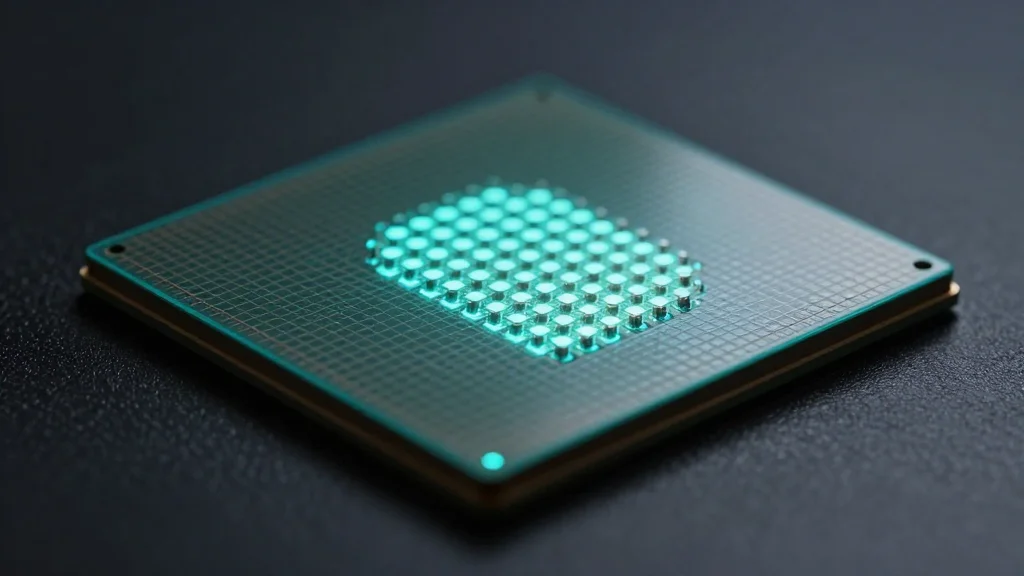
Loughborough Physicists Unveil Neuromorphic Chip Claiming 2,000‑Fold AI Energy Savings

Why It Matters
The chip’s reported 2,000‑fold energy reduction tackles one of the most pressing constraints on AI deployment: power consumption. As AI models grow larger and edge devices become more ubiquitous, the ability to run inference with minimal energy can unlock new applications in remote or battery‑limited environments. Moreover, the use of a purely physical reservoir—implemented through nanometre‑scale pores—offers a fundamentally different computing paradigm that could complement, rather than replace, existing digital accelerators. Beyond immediate power savings, the research demonstrates that nanofabricated memristors can serve as analog processors for temporal data, a capability that software‑based systems struggle to emulate efficiently. This could spur a wave of hybrid architectures where analog front‑ends handle time‑series preprocessing while digital back‑ends perform higher‑level reasoning, potentially redefining the hardware stack for AI.
Key Takeaways
- •Loughborough University researchers built a niobium‑oxide memristor chip with random nanopores.
- •The device achieved up to 2,000× lower energy consumption versus conventional software for tasks like XOR, image recognition, and Lorenz‑63 prediction.
- •Experiments showed accurate short‑term forecasting of chaotic time series and successful digit classification.
- •The work was published in Advanced Intelligent Systems and funded by the UK Engineering and Physical Sciences Research Council.
- •Next steps include scaling to multi‑chip modules and field trials slated for 2027.
Pulse Analysis
The Loughborough breakthrough arrives at a moment when the AI hardware market is saturated with digital accelerators that rely on ever‑larger transistor counts and aggressive voltage scaling. While companies such as NVIDIA and AMD push performance through parallelism, they also face diminishing returns on power efficiency. The memristor‑based approach sidesteps this ceiling by exploiting analog physics to perform computation, a strategy reminiscent of early neuromorphic projects at IBM and Intel but now grounded in nanometre‑scale fabrication.
Historically, reservoir computing has been a theoretical curiosity, limited by the difficulty of building stable, reproducible physical reservoirs. The random nanopore architecture described in the Loughborough paper provides a manufacturable route, leveraging existing oxide deposition techniques. If the team can integrate these reservoirs with CMOS control circuitry, they could deliver a hybrid chip that offers the best of both worlds: ultra‑low‑power analog preprocessing and the flexibility of digital post‑processing.
Looking ahead, the real test will be commercial viability. Scaling from a single memristor device to dense arrays introduces challenges in variability, endurance, and interfacing. Yet the promise of orders‑of‑magnitude energy savings is likely to attract venture capital and government funding, especially as Europe doubles down on sovereign AI hardware initiatives. Should the prototype succeed in real‑world edge scenarios, it could catalyze a new class of nanotech‑enabled AI chips that redefine the power envelope for intelligent devices.
Loughborough Physicists Unveil Neuromorphic Chip Claiming 2,000‑Fold AI Energy Savings
Comments
Want to join the conversation?
Loading comments...