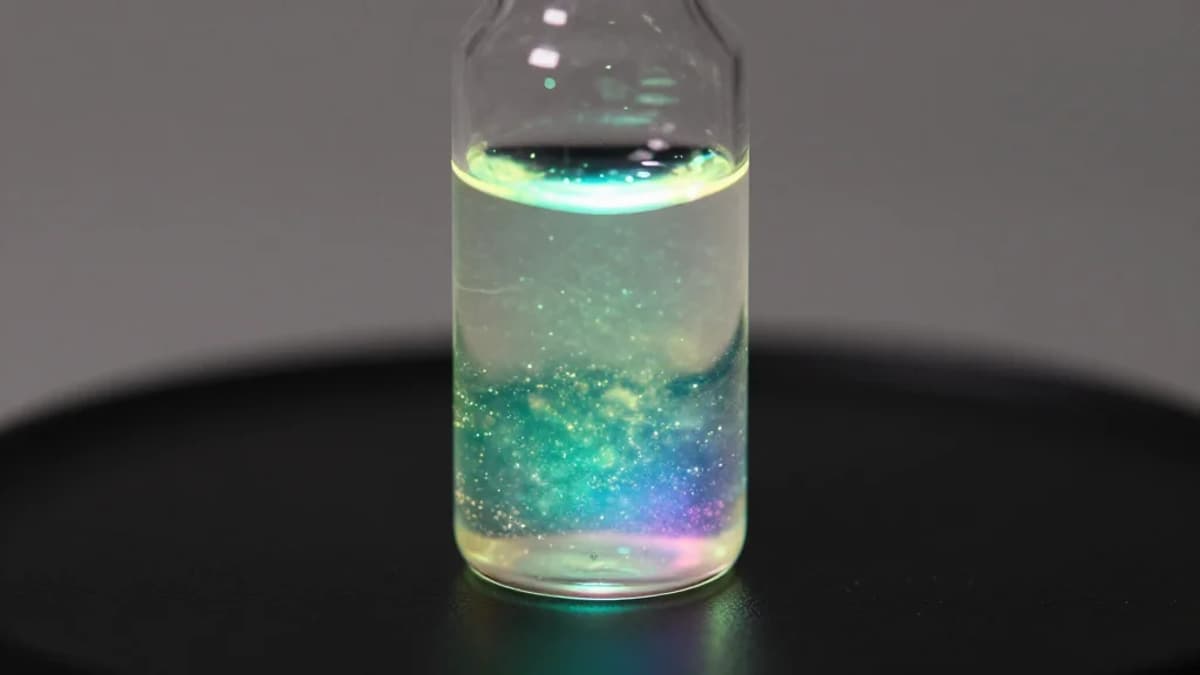
Mass Production Technology Developed for Ultra-High Color Purity Perovskite Emitters
•February 18, 2026
0
Why It Matters
The breakthrough removes cost and safety barriers to scaling perovskite emitters, positioning them to replace quantum dots and OLEDs in ultra‑high‑definition TVs, AR/VR headsets, and other immersive displays. It accelerates commercialization of a material that can meet the expanding Rec. 2020 color standard.
Key Takeaways
- •Cold‑injection enables room‑temperature perovskite nanocrystal synthesis
- •Near‑unity PLQY maintained from lab to 20‑liter scale
- •EQE reaches 29.6% in mass‑produced PeLEDs
- •FWHM ~20 nm meets Rec.2020 color gamut
- •SN Display showcases perovskite tablets at CES 2026
Pulse Analysis
The display industry is racing toward the Rec. 2020 color space, a 40 % expansion over the current DCI‑P3 standard that promises true‑to‑eye visual experiences for 8K TVs, AR glasses, and VR headsets. Existing emitters—organic OLEDs and semiconductor quantum dots—suffer from relatively broad emission spectra, limiting their ability to hit the narrow color bands required for Rec. 2020. Perovskite nanocrystals, with an intrinsic full‑width‑half‑maximum around 20 nm, have long been touted as the only viable solution, but their commercial rollout stalled due to costly, high‑temperature synthesis methods that demand specialized facilities.
Lee’s cold‑injection method overturns those constraints by operating near 0 °C under ambient conditions, sidestepping fire hazards and the need for inert‑gas gloveboxes. The discovery of a pseudo‑emulsion phase slows crystal nucleation, suppresses defects, and yields uniformly sized nanocrystals. Crucially, the process scales to a 20‑liter reactor while preserving near‑unity photoluminescence quantum yield and delivering a record‑breaking 29.6 % external quantum efficiency in fabricated PeLEDs—metrics that were previously confined to bench‑scale experiments.
Commercially, the technology gives SN Display a clear first‑mover advantage. By integrating mass‑produced perovskite films into tablet displays showcased at CES 2026, the startup demonstrates a viable supply chain from synthesis to end‑product. The reduced capital expenditure and safety profile open the door for large‑volume manufacturers to adopt perovskite emitters, potentially displacing quantum‑dot backlights and OLED stacks in premium devices. As the ecosystem matures, we can expect a cascade of partnerships, accelerated standard‑setting, and a rapid price decline that will make Rec. 2020‑compliant displays mainstream within the next few years.
Mass production technology developed for ultra-high color purity perovskite emitters
0
Comments
Want to join the conversation?
Loading comments...