Micro-LEDs Light Up Nanowire Emitters for Chip-Scale Photonics
Why It Matters
The technique offers a scalable path to on‑chip light sources for photonic integrated circuits, accelerating the transition from laboratory prototypes to commercial high‑density optical interconnects.
Key Takeaways
- •Transfer‑printed micro‑LEDs excite InP nanowires on chip.
- •Modulation achieved at tens of MHz, room temperature operation.
- •Integration accuracy under 500 nm, serial speed >1 device/min.
- •Optical power at nanowire ~300 nW, efficiency lower than lasers.
- •Approach enables programmable high‑density nanowire photonic circuits.
Pulse Analysis
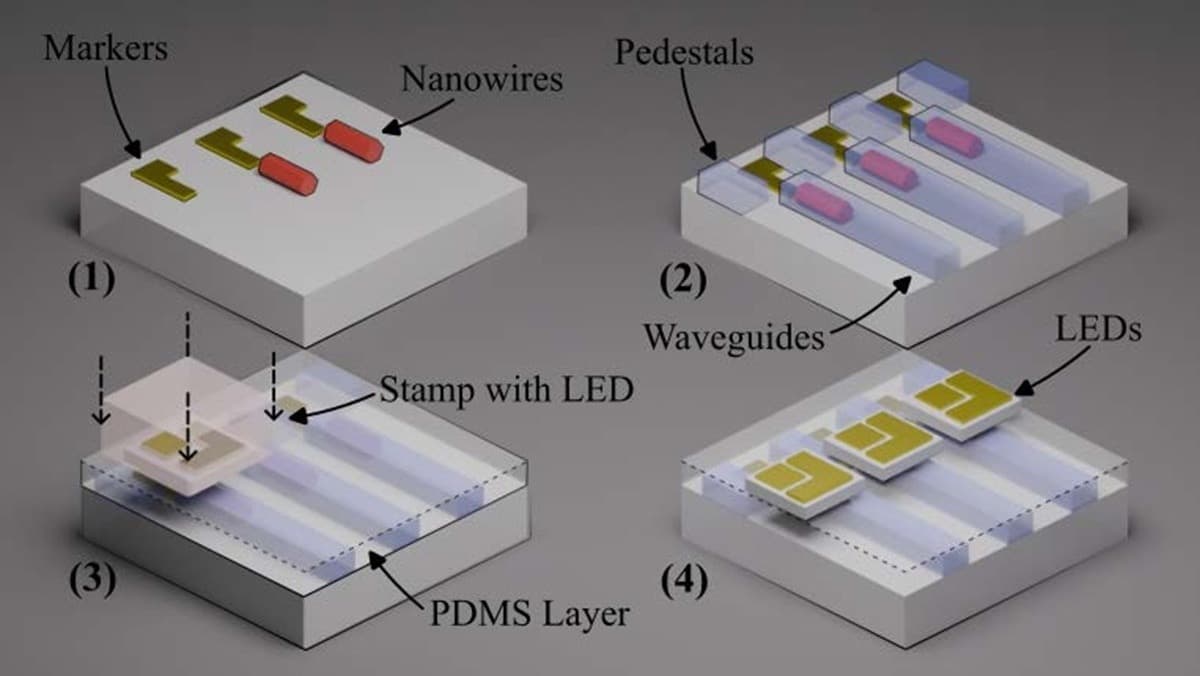
Nanowire emitters have long promised ultra‑compact light sources for photonic integrated circuits, but their adoption has been hampered by the lack of efficient, on‑chip excitation methods. Traditional approaches rely on external lasers or complex waveguide couplers, which add bulk and alignment challenges. By leveraging the maturity of micro‑LED technology—already pervasive in displays and visible‑light communications—researchers have introduced a hybrid integration route that sidesteps these hurdles, embedding the pump source directly where it is needed.
The transfer‑printing process described in the recent Nanotechnology paper aligns micro‑LED membranes with nanowire waveguides to within 500 nm, a precision comparable to advanced semiconductor packaging. This method supports a throughput of more than one device per minute, making it compatible with high‑volume manufacturing. Performance metrics show tens‑of‑megahertz modulation and room‑temperature operation, delivering near‑infrared emission at 860 nm. Although the optical overlap between the 470 nm LED output and the nanowire absorber is below 1 %, resulting in modest power levels (~300 nW), the proof‑of‑concept validates the concept of electrically driven, on‑chip nanowire excitation.
Industry implications are significant. A scalable, electrically addressable light source could accelerate the rollout of dense photonic interconnects in data centers, enable on‑chip LiDAR for autonomous vehicles, and support quantum photonics platforms that require precise, programmable emitters. Future work will likely focus on improving coupling efficiency—potentially through metasurface lenses or optimized waveguide designs—and integrating wire‑bonded or flip‑chip packaging for robust deployment. As these refinements mature, the micro‑LED‑nanowire hybrid could become a cornerstone technology for next‑generation optical computing and communication systems.
Micro-LEDs Light Up Nanowire Emitters for Chip-Scale Photonics
Comments
Want to join the conversation?
Loading comments...