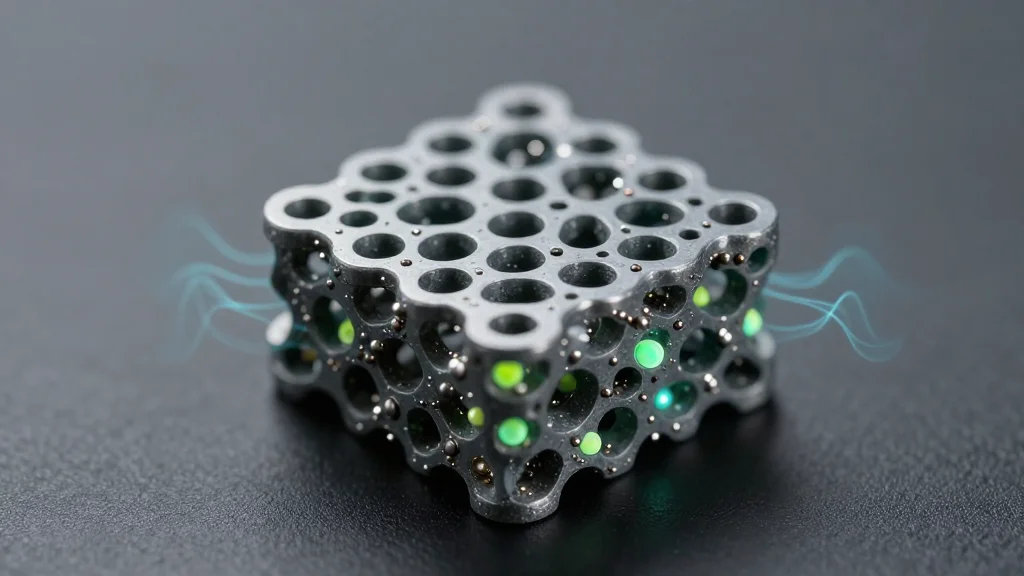
MOF‐on‐MOF‐Derived CeO2/Fe@C Composites for Tunable Low‐Frequency Electromagnetic Wave Absorption
Why It Matters
The approach offers a scalable, tunable route to ultrathin low‑frequency EM absorbers, addressing the growing demand for EMI shielding, 5G infrastructure, and radar‑stealth technologies. Temperature‑controlled synthesis adds design flexibility for targeted frequency windows.
Key Takeaways
- •MOF-on-MOF precursor yields CeO2/Fe@C composites with tunable absorption
- •CFC‑2 achieves −62.2 dB RL at 7.84 GHz, 1.70 mm thickness
- •Raising pyrolysis temperature shifts optimal loss to 4 GHz, −42.5 dB
- •Interface polarization and magnetic loss balance improve impedance matching
- •Fe nanoparticles and oxygen vacancies drive multi‑scale attenuation mechanisms
Pulse Analysis
Low‑frequency electromagnetic interference (EMI) has become a critical challenge as wireless communication standards expand into the 2‑8 GHz range. Traditional absorbers often rely on bulky ferrite or carbon‑based materials that struggle to maintain thin profiles while delivering strong attenuation. Recent advances in metal‑organic frameworks (MOFs) provide a versatile platform for engineering hierarchical structures with precise compositional control, opening new pathways for lightweight, high‑performance absorbers.
In the reported work, researchers leveraged an in‑situ growth strategy to fabricate a UiO‑66@MIL‑88B MOF‑on‑MOF precursor, then subjected it to temperature‑programmed pyrolysis. This process simultaneously carbonizes the organic ligands and reduces iron species, yielding a CeO2/Fe@C composite (CFC). By tuning the pyrolysis temperature, they modulated CeO2 crystallinity and interface density, achieving a remarkable –62.2 dB reflection loss at 7.84 GHz for CFC‑2 and shifting the absorption peak to 4 GHz with –42.5 dB loss for CFC‑3. The ultrathin 1.70 mm thickness and 5.36 GHz effective bandwidth underscore the material’s capability to meet stringent size constraints without sacrificing performance.
The implications extend beyond academic interest. Industries ranging from aerospace to consumer electronics require compact, broadband EMI shielding that operates at lower frequencies to protect sensitive components and reduce radar cross‑section. The CFC platform’s tunable absorption, driven by multi‑scale interfacial polarization and magnetic loss from Fe nanoparticles, offers a practical solution that can be integrated into coatings, composites, or printed circuits. Future research may explore scaling the synthesis, combining the CFCs with polymer matrices, or tailoring vacancy concentrations to further refine impedance matching, positioning MOF‑derived absorbers as a cornerstone of next‑generation electromagnetic management strategies.
MOF‐on‐MOF‐Derived CeO2/Fe@C Composites for Tunable Low‐Frequency Electromagnetic Wave Absorption
Comments
Want to join the conversation?
Loading comments...