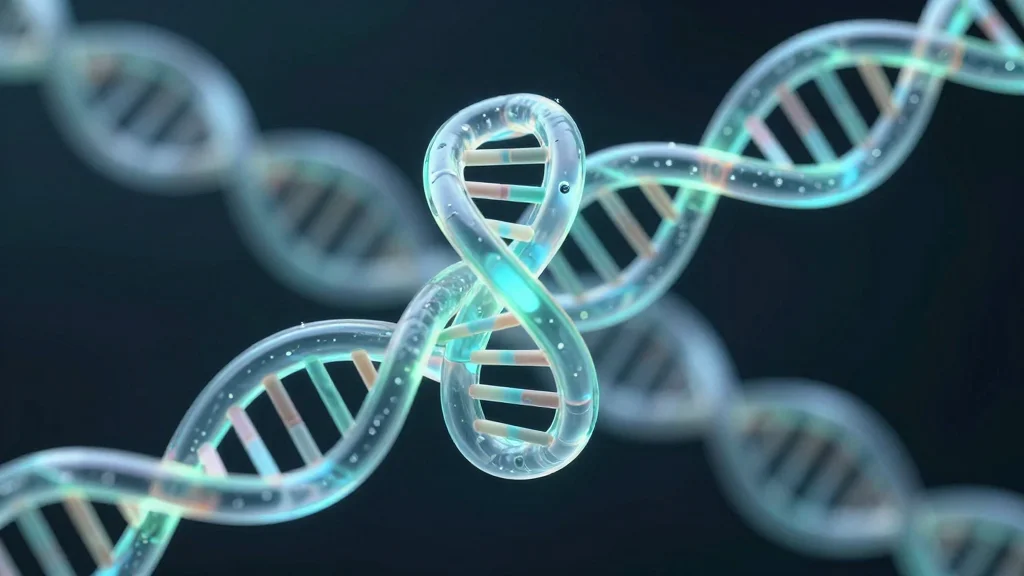
Molecular Chainmail Made From Thousands of Interlocking DNA Rings
Key Takeaways
- •16,000 unique DNA rings form a true Olympic gel.
- •Interlocking topology provides elasticity without covalent cross‑links.
- •Critical gelation concentration identified at 0.11 wt %.
- •Sticky‑end lock‑key design suppresses linear polymerization.
- •Potential for DNA‑based microreactors and biodegradable membranes.
Pulse Analysis
The idea of a gel held together solely by topological interlocks dates back to de Gennes’ 1979 proposal of an “Olympic gel.” Unlike conventional hydrogels that rely on covalent or supramolecular cross‑links, such a material would derive its mechanical strength from the sheer number of concatenated rings. For decades researchers struggled to produce the required ring density because linear polymerization dominates at high concentrations. The recent Advanced Materials paper finally overcomes this barrier by exploiting a combinatorial library of over 16 000 DNA plasmid rings, turning a long‑standing theoretical construct into a tangible material.
The authors introduced a diversified lock‑and‑key strategy in which each plasmid carries a unique 16‑base sticky‑end pair. Matched ends bind four times stronger than mismatches, biasing intramolecular cyclisation and preventing chain growth. After nicking and thermal cycling, open rings thread through neighboring rings before resealing, locking the interlocked topology. Atomic‑force microscopy and cryogenic SEM confirmed a mesh of mechanically linked rings with no linear multimers. Rheological tests revealed a solid‑like response above 0.11 wt % concentration, sub‑linear stress‑strain scaling (exponent ≈0.78) and long‑term energy storage, hallmarks of a true topological gel.
The DNA‑based nature of the gel opens routes unavailable to synthetic polymers. Therapeutic sequences can be embedded in the plasmid backbone, turning the material into a biodegradable microreactor that continuously transcribes mRNA or other bio‑actives. Its permeability and mechanical resilience also make it a candidate for ultrafiltration membranes and soft robotics components. More broadly, the work demonstrates that combinatorial sequence complexity can be harnessed to dictate macroscopic material properties, suggesting a new design paradigm where information‑rich biomolecules replace traditional chemical cross‑links in advanced soft matter engineering.
Molecular chainmail made from thousands of interlocking DNA rings
Comments
Want to join the conversation?