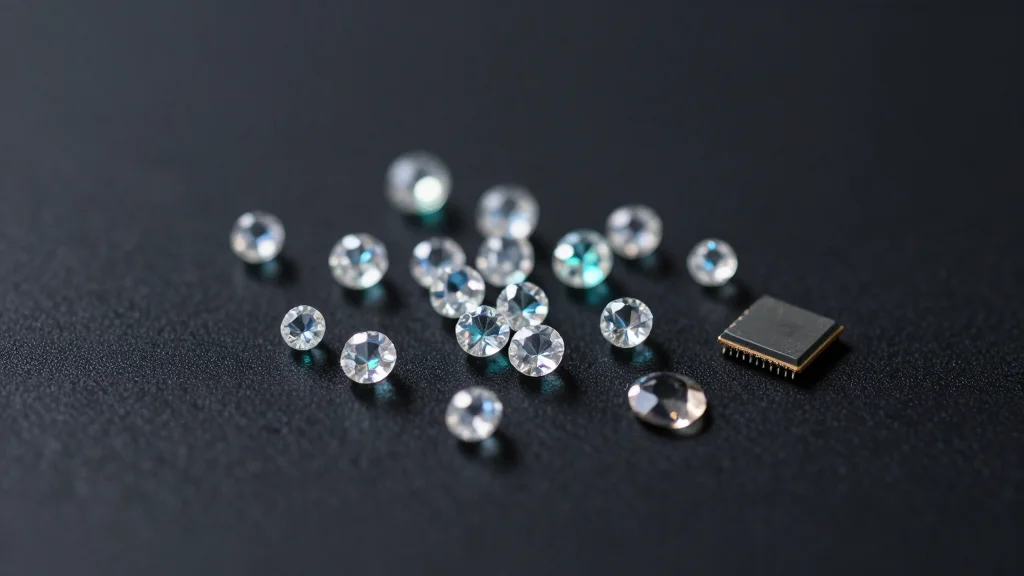
Molecular‑Design Method Yields Uniform 3‑4 Nm Nanodiamonds for Quantum and Biomedical Use

Why It Matters
The ability to synthesize nanodiamonds with atomic‑level control over size and defect chemistry removes a long‑standing bottleneck in two fast‑growing sectors. Quantum sensors depend on defect centres that emit photons with exact wavelengths and minimal spectral noise; inconsistencies in particle size and impurity levels have limited device performance and reproducibility. By delivering uniform, defect‑engineered nanodiamonds, the new method could accelerate the commercialization of quantum‑enhanced microscopes, navigation systems, and secure communication devices. In biomedicine, fluorescent nanodiamonds are already used for long‑term cell labeling because they do not bleach like organic dyes. Smaller, monodisperse particles improve tissue penetration and reduce aggregation, which translates into clearer images and lower toxicity. The bottom‑up synthesis therefore not only expands the toolbox for researchers but also paves the way for regulatory‑friendly manufacturing pipelines that meet Good Manufacturing Practice (GMP) standards.
Key Takeaways
- •Researchers at Max Planck Institute created 3‑4 nm nanodiamonds using nanographene precursors.
- •High‑pressure, high‑temperature conversion yields narrow size distribution (<0.5 nm spread).
- •Silicon‑ and germanium‑vacancy colour centres are incorporated during synthesis, avoiding post‑processing.
- •Uniform nanodiamonds improve quantum sensor precision and enable brighter, more stable bio‑imaging probes.
- •The method promises scalable production compatible with existing high‑pressure equipment.
Pulse Analysis
The molecular‑design breakthrough arrives at a moment when the nanodiamond market is poised for rapid expansion. According to market research, global demand for nanodiamond‑based quantum devices could exceed $1 billion by 2030, driven by investments from telecom, defense, and health‑tech firms. Historically, the supply chain has been constrained by the stochastic nature of top‑down milling, which forces manufacturers to over‑engineer devices to accommodate variability. The new bottom‑up route effectively decouples product performance from supply uncertainty, a shift that could trigger a wave of vertical integration as chipmakers and biotech firms bring nanodiamond synthesis in‑house.
From a competitive standpoint, the Max Planck team’s approach may challenge established players like Element Six and NanoCarbon Research, who have relied on high‑energy detonation methods. Those companies will need to either adopt similar molecular‑design techniques or differentiate through proprietary surface‑functionalization chemistries. The study also underscores the growing convergence of chemistry and quantum engineering; the ability to program defect chemistry at the molecular level blurs the line between material synthesis and device design, suggesting that future breakthroughs will emerge from interdisciplinary labs rather than isolated manufacturing units.
Looking ahead, the key question is whether the laboratory‑scale process can be industrialized without sacrificing the precise control that defines its advantage. Scaling high‑pressure reactors is non‑trivial, but recent advances in large‑volume diamond anvil cells and continuous‑flow high‑temperature reactors hint at feasible pathways. If successful, the technology could lower the cost per milligram of high‑purity nanodiamonds from current tens of thousands of dollars to a few hundred, democratizing access for startups and academic groups alike. Such a price drop would likely accelerate innovation cycles, leading to new applications we have yet to imagine, from quantum‑enhanced wearables to next‑generation diagnostic nanoprobes.
Molecular‑Design Method Yields Uniform 3‑4 nm Nanodiamonds for Quantum and Biomedical Use
Comments
Want to join the conversation?
Loading comments...