Multifunctional Superwetting Sea‐Urchin‐Mimetic Nanosheet‐Based Interface for Remote Oil‐Water Separation
•January 25, 2026
0
Companies Mentioned

Why It Matters
The technology offers a low‑toxicity, remotely operable solution for large‑scale oil spill remediation, reducing response time and environmental exposure. Its modular, reusable design could lower cleanup costs and accelerate adoption in maritime disaster response.
Key Takeaways
- •Fluorine-free FBC‑rGO coating achieves >154° water contact angle
- •Oil uptake capacity reaches 15‑65 g per gram sorbent
- •Integrated Wi‑Fi mini‑bot enables remote, contactless oil recovery
- •Coating resists >90% corrosion in simulated seawater
- •Recyclable performance maintains >97% separation efficiency after cycles
Pulse Analysis
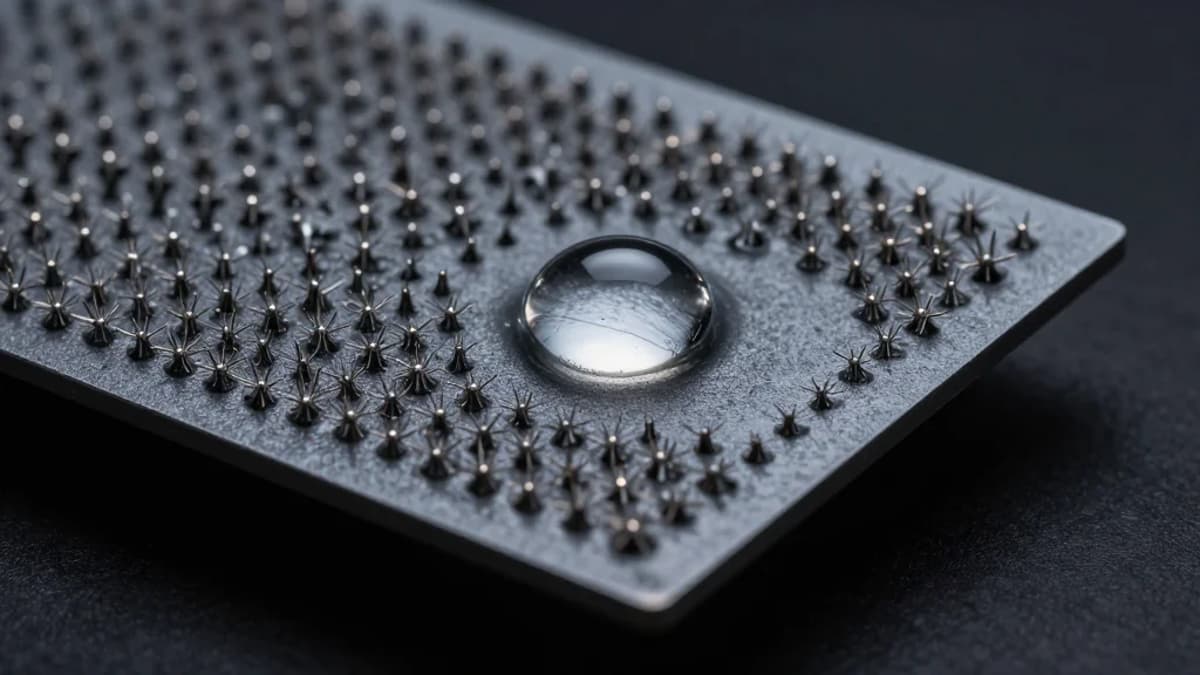
Oil spills continue to pose severe ecological and economic threats, and traditional mechanical skimmers or chemical dispersants often require close human intervention and can introduce additional pollutants. In recent years, researchers have turned to bio‑inspired surface engineering to create materials that selectively attract oil while repelling water, thereby simplifying the separation process. The latest advance leverages a sea‑urchin‑mimetic nanosheet architecture that combines hierarchical roughness with tailored surface chemistry, delivering a contact‑angle profile that rivals the best fluorinated coatings without the associated environmental burden.
The core of the new platform is a fluorine‑free composite of oleic‑acid‑functionalized barium carbonate (FBC) and reduced graphene oxide (rGO) nanosheets. FBC introduces polar‑nonpolar asymmetry and spine‑like protrusions, while rGO supplies ultra‑low surface energy and mechanical reinforcement through π‑π interactions. This dual‑design stabilizes a metastable Cassie‑Baxter state, producing water contact angles above 154° and oil contact angles near 0°, enabling oil uptake capacities of 15‑65 g per gram and separation efficiencies exceeding 97%. Moreover, the coating resists more than 90% corrosion in simulated seawater and remains self‑cleaning after exposure to complex biofluids.
To translate laboratory performance into field capability, the researchers mounted the FBC‑rGO membrane on a dolphin‑inspired, Wi‑Fi‑controlled mini‑bot equipped with an onboard pump and oil storage compartment. The robot can be directed remotely, allowing contactless extraction of oil from hazardous zones and eliminating the need for personnel to enter contaminated water. Its modular design supports rapid swapping of sorbent panels and battery packs, making it adaptable to varying spill sizes and marine conditions. If scaled, this technology could lower remediation costs, reduce ecological footprints, and set new standards for autonomous environmental cleanup.
Multifunctional Superwetting Sea‐Urchin‐Mimetic Nanosheet‐Based Interface for Remote Oil‐Water Separation
0
Comments
Want to join the conversation?
Loading comments...