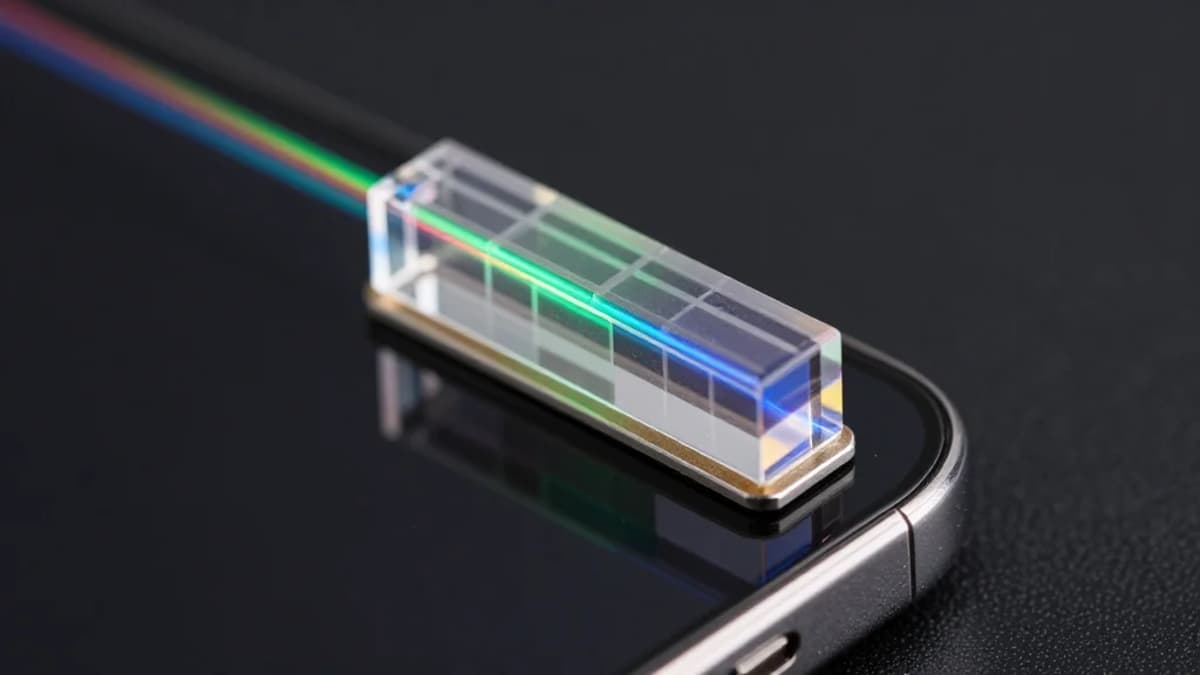
Nanophotonic Color Router Solves Smartphone Camera Angle Problem
•February 23, 2026
0
Why It Matters
Stable color separation at wide angles enables thinner, higher‑resolution smartphone cameras and accelerates adoption of metasurface optics across consumer imaging devices.
Key Takeaways
- •78% efficiency at ±12° incidence
- •Inverse design automates metamaterial optimization
- •Samsung's “Nano Prism” shows commercial readiness
- •Enables accurate color separation for tiny smartphone pixels
- •Design method applicable to broader nanophotonic devices
Pulse Analysis
Smartphone cameras are shrinking while users demand higher resolution and true‑to‑life colors. Traditional lens stacks struggle to gather enough light as pixel pitches fall below a few micrometers, leading to color crosstalk and reduced dynamic range. Researchers at KAIST and Hanyang University responded with a nanophotonic color router that replaces part of the lens system with a metasurface engineered to split incoming light into red, green, and blue channels at the sensor level.
By routing light at the sub‑wavelength scale, the device promises sharper images without enlarging the camera module. The breakthrough lies in an inverse‑design algorithm that lets a computer generate the optimal arrangement of nanostructures, rather than relying on trial‑and‑error geometry. The resulting metasurface maintains roughly 78 % optical efficiency across a ±12‑degree field of view, a stark improvement over earlier routers that failed beyond a few degrees. Samsung’s prototype, branded “Nano Prism,” demonstrates that the design can be transferred to commercial image sensors, offering consistent color separation even when light arrives at oblique angles typical of handheld photography.
Beyond smartphones, the robust design methodology can be applied to a wide range of nanophotonic components such as spectrometers, LiDAR modules, and augmented‑reality displays, accelerating the adoption of metasurfaces in consumer electronics. The ability to preserve color fidelity without bulky optics opens new form‑factor possibilities for wearables and IoT cameras, potentially reshaping supply chains that currently depend on complex lens assemblies. As manufacturers integrate these routers, we can expect faster time‑to‑market for ultra‑compact imaging systems and a competitive edge for firms that master metamaterial production.
Nanophotonic color router solves smartphone camera angle problem
0
Comments
Want to join the conversation?
Loading comments...