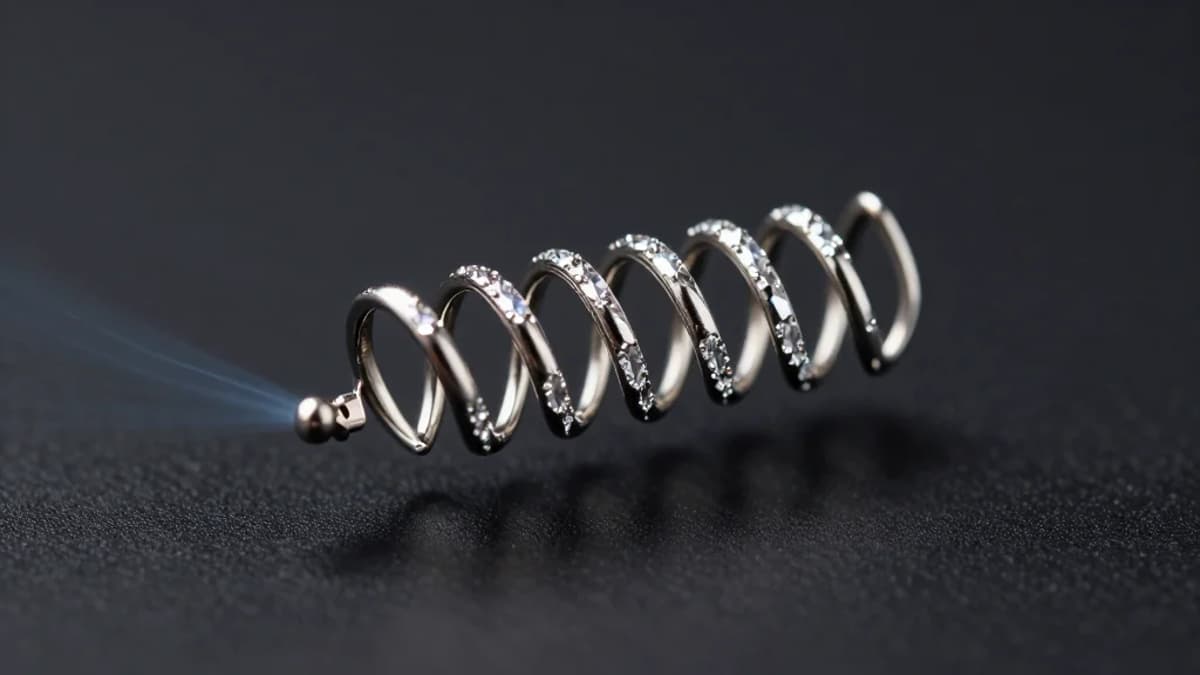
Nanosculpted 3D Helices of a Magnetic Weyl Semimetal with Switchable Non-Reciprocal Electron Transport
•January 21, 2026
0
Why It Matters
The work demonstrates that 3D geometry can actively control chiral charge transport, opening pathways for compact, low‑power spintronic diodes and logic elements.
Key Takeaways
- •Focused ion beam creates 3D helical Co₃Sn₂S₂ nanostructures
- •Helices exhibit switchable non‑reciprocal electron transport
- •Current induces 100% magnetisation reversal in helices
- •Nonlinear resistance scales with I², confirming rectification
- •Demonstrates 3D geometry as control knob for chiral spintronics
Pulse Analysis
Weyl semimetals have reshaped the landscape of topological electronics by hosting chiral quasiparticles that respond asymmetrically to external fields. While planar devices have showcased anomalous Hall effects and magnetochiral anisotropy, extending these phenomena into the third dimension remained largely theoretical. By leveraging focused ion beam milling, the RIKEN team transformed bulk Co₃Sn₂S₂ crystals into nanoscale helices, preserving the bulk’s Weyl nodes while imposing a curvilinear magnetic texture that couples geometry with electronic chirality.
Transport experiments on the helices reveal a striking non‑reciprocal response: the resistance depends on the direction of current flow and can be toggled by reversing the magnetisation. Second‑harmonic voltage signals scale with the square of the applied current, a hallmark of ballistic rectification in chiral conductors. Moreover, the authors demonstrate deterministic current‑driven magnetisation switching, achieving near‑complete reversal without external magnetic fields. These findings confirm that curvature‑induced spin‑orbit coupling and the intrinsic Berry curvature of the Weyl semimetal synergistically amplify magnetochiral effects, delivering performance metrics that surpass many existing two‑dimensional platforms.
The ability to engineer switchable, direction‑dependent transport in a compact 3D architecture has immediate implications for spintronic circuitry. Devices such as superconducting diodes, non‑volatile memory elements, and low‑energy logic gates could exploit the helices’ intrinsic rectification without relying on external biasing schemes. Furthermore, the open‑access dataset enables rapid computational modeling and integration with emerging design tools for three‑dimensional nanomagnetism. As industry pushes toward denser, multifunctional components, geometry‑driven chiral transport offers a versatile route to embed topological protection and energy efficiency into next‑generation electronic systems.
Nanosculpted 3D helices of a magnetic Weyl semimetal with switchable non-reciprocal electron transport
0
Comments
Want to join the conversation?
Loading comments...