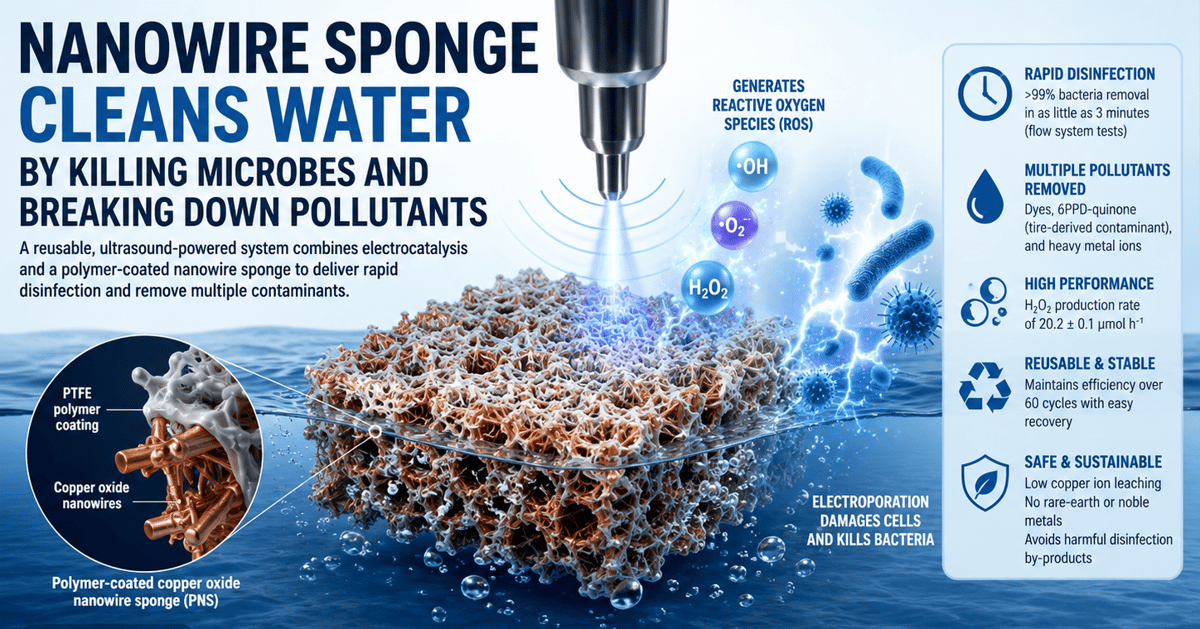
Nanowire Sponge Cleans Water by Killing Microbes and Breaking Down Pollutants
Why It Matters
The technology offers a fast, metal‑free, and recyclable solution for both microbial disinfection and chemical pollutant removal, addressing a critical gap in sustainable wastewater treatment.
Key Takeaways
- •Ultrasound‑triggered nanowire sponge achieves >99% disinfection in 3 minutes
- •System degrades tire‑derived 6PPD‑quinone and multiple dye pollutants
- •Generates 20.2 µmol h⁻¹ hydrogen peroxide without noble metals
- •Reusable polymer coating prevents copper leaching and simplifies recovery
- •Scalable CEC platform offers energy‑efficient, residue‑free water treatment
Pulse Analysis
The growing scarcity of clean water has pushed researchers to look beyond conventional biochemical treatments, which often rely on costly catalysts and generate secondary waste. Contact electrocatalysis (CEC) merges mechanochemistry with redox reactions, using solid‑liquid charge transfer to produce reactive oxygen species (ROS). By embedding copper‑oxide nanowires in a porous copper sponge and coating them with a fluorinated polymer, the new system maximizes surface area while maintaining water compatibility, enabling ultrasonically driven ROS bursts that attack both microbes and organic contaminants.
Performance data from the Nature Communications study highlight the platform’s speed and versatility. In batch and flow‑through experiments, the polymer‑coated nanowire sponge (PNS) delivered >99% bacterial kill in three minutes and degraded a suite of dyes, the tire‑derived pollutant 6PPD‑quinone, and heavy‑metal ions under ambient conditions. The reported hydrogen peroxide generation of 20.2 µmol h⁻¹ rivals many traditional advanced oxidation processes, yet it avoids noble‑metal catalysts and the formation of harmful disinfection by‑products. The PTFE coating also curtails copper leaching, ensuring that the treatment itself does not introduce new contaminants.
For the water‑treatment industry, the PNS‑based CEC system promises a scalable, energy‑efficient alternative that can be integrated into point‑of‑use devices or larger municipal facilities. Its reusable nature reduces operational costs, while the reliance on inexpensive copper and polymer materials sidesteps supply‑chain constraints tied to rare‑earth elements. Future work will need to optimize ultrasonic energy distribution and transducer design for large‑scale deployment, but the study establishes a compelling blueprint for residue‑free, multifunctional water purification that aligns with circular‑economy principles.
Nanowire Sponge Cleans Water by Killing Microbes and Breaking Down Pollutants
Comments
Want to join the conversation?
Loading comments...