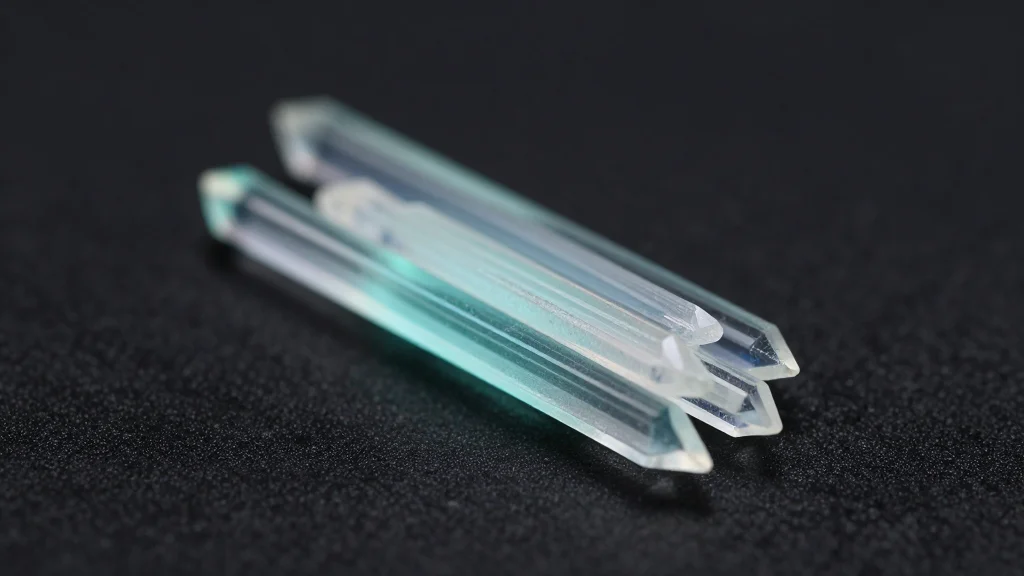
National Lab Unveils Vanadium‑Oxide Synapse with 25‑Minute Photoresponse for Neuromorphic Vision

Why It Matters
The breakthrough addresses two long‑standing challenges in neuromorphic engineering: achieving biologically realistic temporal dynamics and minimizing energy draw. By replicating the persistent photoconductivity of the human eye with a solid‑state material, the technology bridges the gap between biological vision and silicon‑based sensors, potentially unlocking ultra‑low‑power AI that can operate in remote or edge environments. Additionally, the broadband response—including infrared—expands the functional envelope of machine vision beyond what conventional cameras can capture, opening new opportunities in defense, environmental monitoring, and medical imaging. Beyond immediate applications, the discovery validates a materials‑by‑design approach where atomic‑scale defects are engineered to produce desired electronic behavior. This paradigm could accelerate the development of other nanotech components—such as memristors and quantum sensors—by providing a clear roadmap for defect engineering.
Key Takeaways
- •NLR team reports V₂O₅ optoelectronic synapse with >25‑minute charge persistence, a record in the field.
- •Oxygen vacancies create polarons that trap photogenerated electrons, enabling long‑term optical memory.
- •Device operates across visible to infrared wavelengths, offering multispectral imaging capabilities.
- •Simplified circuitry reduces power consumption and signal interference compared with traditional sensor‑memory stacks.
- •Prototype vision chip targeting milliwatt‑scale operation is planned for demonstration by late 2026.
Pulse Analysis
The V₂O₅ synapse marks a decisive shift from incremental improvements in photodetector speed toward a fundamentally different design philosophy: leveraging defect‑engineered materials to embed memory directly in the sensing layer. Historically, neuromorphic vision has relied on separate photodiodes and memristive elements, which introduces latency and energy overhead. By collapsing these functions, the NLR approach could redefine the power‑performance envelope for edge AI, making truly autonomous perception feasible in battery‑constrained platforms such as drones or implantable devices.
From a market perspective, the timing aligns with heightened investment in low‑power AI chips, where major semiconductor firms are courting startups that promise orders‑of‑magnitude energy savings. If the V₂O₅ process can be transferred to high‑volume manufacturing, it may attract strategic partnerships with companies like Intel, Sony, or emerging vision‑sensor firms. The involvement of the DOE’s reMIND center also signals federal backing, which could translate into grant funding or procurement contracts for defense and space applications.
Looking ahead, the key risk lies in scaling the vacancy‑control technique from lab‑scale crystals to wafer‑scale production without compromising uniformity. Success will depend on advances in atomic‑layer deposition and in‑situ monitoring of defect densities. Should these hurdles be overcome, the technology could catalyze a new class of neuromorphic sensors that not only see but also remember, fundamentally altering how machines interpret the visual world.
National Lab Unveils Vanadium‑Oxide Synapse with 25‑Minute Photoresponse for Neuromorphic Vision
Comments
Want to join the conversation?
Loading comments...