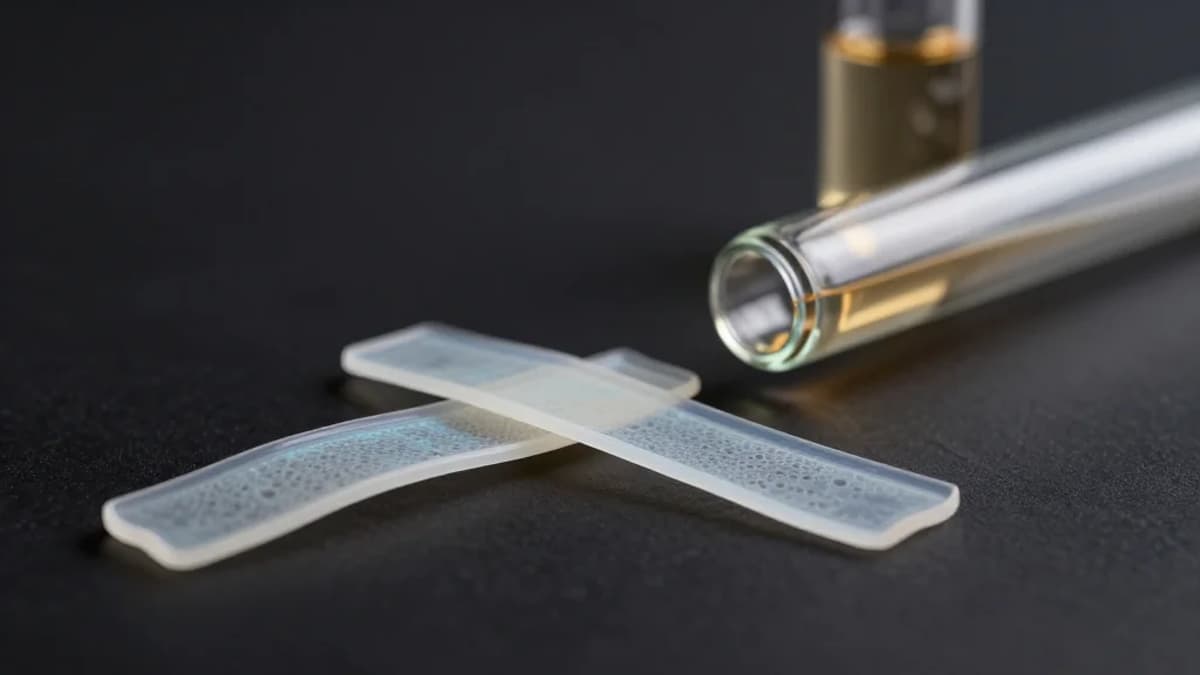
New 2D Membrane Reactor Improves Photocatalytic Synthesis
•March 2, 2026
0
Why It Matters
The breakthrough offers a scalable, energy‑efficient route to produce imines, key precursors for pharmaceuticals and agrochemicals, reducing reliance on harsh reagents and batch processes. It signals a shift toward membrane‑based photocatalysis for sustainable chemical manufacturing.
Key Takeaways
- •2D TiO2 membrane achieves 99.2% conversion in 7 seconds
- •Continuous-flow photocatalysis reduces energy and catalyst costs
- •Angstrom-scale channels enhance charge separation and reactant adsorption
- •DFT shows titanium vacancies lower reaction energy barrier
- •Larger interlayer spacing promotes hydrogen‑bonded transition state
Pulse Analysis
The synthesis of imines—versatile building blocks for drugs, agrochemicals and advanced materials—has long depended on stoichiometric dehydrating agents, strong acids or expensive metal catalysts. These batch‑type processes generate waste, consume energy and limit process control, prompting a search for greener alternatives. The recent introduction of a two‑dimensional titanium‑oxide membrane reactor addresses these shortcomings by coupling light‑driven catalysis with continuous‑flow operation. By confining reactants within angstrom‑scale channels, the system transforms a traditionally labor‑intensive step into a rapid, ambient‑temperature reaction.
Performance data underline the reactor’s impact: 99.2 % conversion and 99.3 % selectivity are achieved in less than seven seconds, a stark contrast to the 54 % conversion after six hours observed with dispersed TiO₂ nanosheets. The membrane’s architecture promotes swift charge transport and suppresses electron‑hole recombination, while titanium vacancies created during vacuum‑assisted assembly lower the activation energy for benzylamine coupling. Density‑functional‑theory calculations confirm stronger reactant adsorption, and molecular‑dynamics simulations reveal that wider interlayer spacings facilitate hydrogen‑bond formation, stabilizing the transition state.
From a commercial perspective, the technology offers a pathway to continuous, low‑temperature imine production with minimal solvent and catalyst footprints. Its modular design can be integrated into existing flow‑chemistry platforms, accelerating scale‑up for pharmaceutical intermediates and specialty chemicals. Moreover, the principles of nanoscale confinement and vacancy engineering are transferable to other photocatalytic transformations, potentially reshaping the broader fine‑chemical sector. As sustainability mandates tighten, membrane‑based photocatalysis is poised to become a cornerstone of next‑generation green manufacturing.
New 2D membrane reactor improves photocatalytic synthesis
0
Comments
Want to join the conversation?
Loading comments...