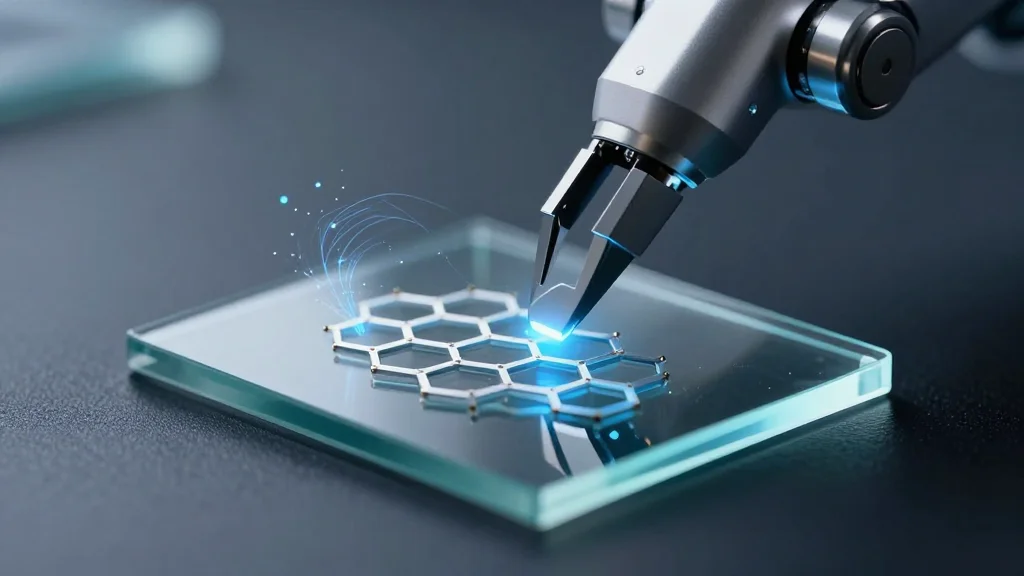
New Embodied AI System Realizes First AI-Created Graphene and Graphene FET
Why It Matters
Qumus eliminates the labor‑intensive bottlenecks of 2D‑material research, accelerating reproducible device production and paving the way for scalable, data‑driven graphene technologies.
Key Takeaways
- •Qumus autonomously isolated a 245 μm² graphene flake in 4 hours
- •First AI‑driven fabrication of a graphene field‑effect transistor completed
- •Multi‑agent LLM framework coordinates robot arms, vision and temperature control
- •Digital metadata logged at each step enables future machine‑learning optimization
- •Scalable design could extend to air‑sensitive 2D materials in gloveboxes
Pulse Analysis
Graphene’s promise in high‑speed electronics and quantum devices has long been hampered by the painstaking manual hunt for atomically thin flakes and the sub‑micron alignment required for device assembly. Traditional labs rely on skilled technicians to exfoliate bulk crystals, locate suitable flakes under a microscope, and painstakingly stack them—a process that can take days for a single device. By embedding generative AI, computer vision and robotics into a compact mini‑lab, Qumus transforms this workflow into a continuous, self‑optimizing experiment, dramatically shortening the time from raw material to functional device.
At the heart of Qumus is a hierarchical multi‑agent large language model that mirrors a human research team. A central coordinator parses user goals—such as “produce a >200 μm² graphene flake”—and delegates tasks to specialized agents for project management, material selection, and precise robotic execution. Over five closed‑loop optimization cycles, the system explored a four‑dimensional parameter space, adjusting temperature, contact time, massage cycles and tape‑peeling speed to achieve a 245 μm² flake. The subsequent 90‑minute dry‑transfer sequence, guided by real‑time image analysis and Newton’s‑ring detection, assembled a graphene field‑effect transistor with 30 physical actions and 18 AI‑driven decision points, all without human intervention.
The implications extend beyond a single laboratory breakthrough. By automating flake discovery, thickness assessment and heterostructure stacking, Qumus offers reproducible, data‑rich processes that can be scaled across multiple facilities. Integrated digital logs create a shared knowledge base for future machine‑learning models, accelerating the design‑build-test cycle for 2D‑material devices. Looking ahead, adapting the platform to inert‑atmosphere gloveboxes could unlock autonomous fabrication of air‑sensitive materials, moving graphene and related van der Waals heterostructures from bespoke research demos toward commercial, high‑volume production.
New embodied AI system realizes first AI-created graphene and graphene FET
Comments
Want to join the conversation?
Loading comments...