New Framework Reveals Which Food-System Nanoparticles Need Closer Safety Checks
Why It Matters
By pinpointing the nanomaterials that pose the greatest dietary risk, the framework enables regulators and industry to allocate testing resources efficiently and to develop evidence‑based safety standards for the food supply.
Key Takeaways
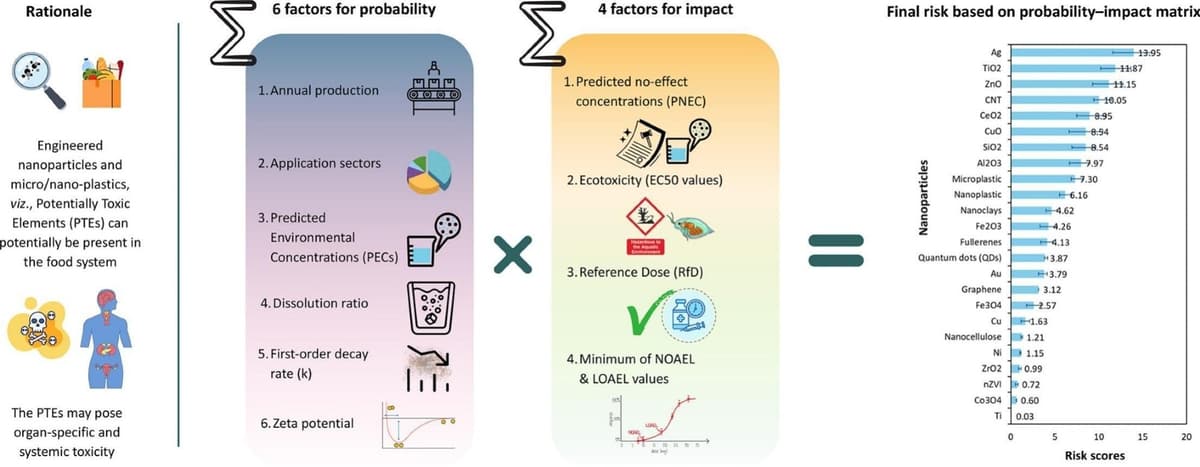
- •Silver, TiO₂, ZnO, CNTs, CeO₂, CuO flagged as high‑priority hazards
- •Exposure likelihood drives rankings more than toxicity data gaps
- •Framework quantifies uncertainty via 100,000 Monte Carlo simulations
- •Nanoplastics rank lower due to limited toxicological evidence
Pulse Analysis
The food chain is increasingly populated by engineered nanoparticles—silver, titanium dioxide, zinc oxide, and a growing suite of nanoplastics—used in packaging, fertilizers, and processing aids. While these materials can improve shelf life or crop yields, their minute size enables them to traverse biological barriers, raising concerns about chronic oral exposure. Traditional risk assessments struggle to keep pace because data on production volumes, environmental fate, and toxicology are scattered across disciplines. Consequently, regulators lack a systematic way to prioritize which particles merit deeper scrutiny, creating a blind spot in food safety governance.
The new probability‑impact matrix addresses that blind spot by assigning each particle a probability score—derived from global production, sector use, predicted environmental concentrations, dissolution rate, persistence constant, and surface charge—and an impact score based on PNEC, EC₅₀, reference dose and NOAEL/LOAEL values. These dimensionless percentiles are aggregated using equal weighting, entropy weight method, or analytic hierarchy process, and fed into 100,000‑iteration Monte Carlo simulations to capture uncertainty. Sensitivity analysis shows exposure drivers dominate ranking variability, while the impact side refines the hazard signal, producing a transparent, updatable prioritization list.
Results consistently elevate silver, TiO₂, ZnO, carbon nanotubes, CeO₂ and CuO as the most urgent candidates for toxicological testing and monitoring in agri‑food matrices. Intermediate rankings for silica, aluminum oxide, and most nanoplastics largely reflect data gaps, signaling where research funding should be directed. For policymakers, the framework offers a defensible screening tool that can be integrated into existing nanomaterial regulations, allowing risk‑based allocation of resources and faster response to emerging hazards. As more exposure and toxicity data become available, the matrix can be recalibrated, ensuring that food‑safety decisions evolve with scientific knowledge.
New Framework Reveals Which Food-System Nanoparticles Need Closer Safety Checks
Comments
Want to join the conversation?
Loading comments...