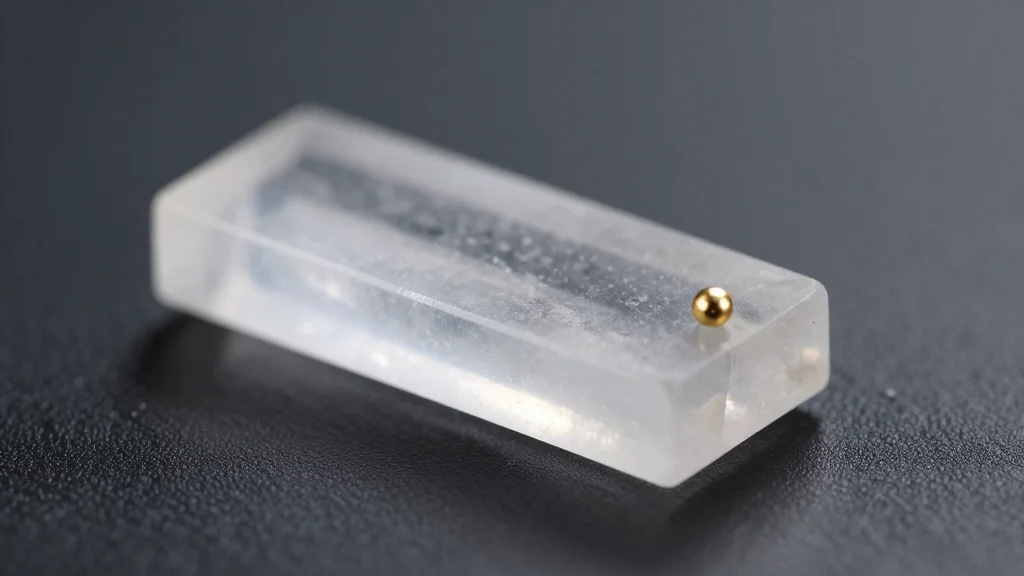
Non‑Linear Resonance Turns Quartz Sensor Into Single‑Particle Detector

Why It Matters
The ability to detect single particles at the femtogram scale using a standard quartz crystal microbalance could democratize ultra‑sensitive mass sensing. Industries ranging from clinical diagnostics to environmental monitoring have long sought affordable, reproducible platforms that can identify trace biomarkers or pollutants without elaborate nanofabrication. By leveraging non‑linear resonance, the new method offers a pathway to achieve laboratory‑grade sensitivity with equipment already present in many labs and manufacturing lines, potentially accelerating time‑to‑market for next‑generation biosensors. Moreover, the approach challenges the dominance of nano‑electromechanical systems in the high‑sensitivity niche. NEMS devices, while powerful, require specialized clean‑room processes and are vulnerable to mechanical fatigue. A QCM‑based solution could provide a more rugged alternative, especially for applications that demand repeated use in harsh or liquid environments, such as point‑of‑care testing or in‑situ water quality monitoring.
Key Takeaways
- •Researchers demonstrated single‑particle detection on a commercial QCM using non‑linear resonance.
- •Detection limit achieved: ~100 femtograms, comparable to leading NEMS sensors.
- •Operating point identified at 6 V drive voltage, producing a sharp amplitude‑drop response.
- •Experiments showed 1 Hz frequency shift for a 1 µm silica particle and for protein‑antibody binding.
- •Method works in liquid environments and requires no surface functionalization or redesign.
Pulse Analysis
The non‑linear QCM breakthrough arrives at a moment when the nanotech sensing market is fragmenting between high‑performance but costly NEMS platforms and more accessible optical or electrochemical sensors. By extracting extra sensitivity from an existing, mass‑produced component, the researchers have effectively created a low‑entry‑barrier technology that could capture a sizable share of the biosensing market, especially in point‑of‑care diagnostics where cost and robustness are paramount. Early adopters are likely to be academic labs and start‑ups focused on rapid assay development, as the technique can be implemented on off‑the‑shelf QCM hardware with minimal modification.
Commercialization, however, will hinge on two factors. First, the electronics that currently limit the observable 1 Hz shift must be refined to fully exploit the intrinsic sensor resolution. Second, the method’s reproducibility across different QCM manufacturers and under varied environmental conditions will need rigorous validation. Companies that already supply QCM instruments—such as QSense (Biolin Scientific) and Stanford Research Systems—could integrate a non‑linear drive mode into their firmware, turning a feature upgrade into a new revenue stream. Meanwhile, pure‑play nanotech firms may seek to license the underlying physics to differentiate their own sensor lines.
In the longer term, the ability to detect femtogram masses without nanofabrication could spur novel assay formats, including label‑free protein interaction studies and real‑time monitoring of aerosol particles. If the technology scales to sensor arrays, it could enable multiplexed detection of dozens of biomarkers simultaneously, a capability that would reshape clinical panels and environmental monitoring networks. The coming months should reveal whether the academic proof‑of‑concept can transition into a commercially viable product line, but the physics alone suggests a compelling new direction for nanotech mass sensing.
Non‑Linear Resonance Turns Quartz Sensor into Single‑Particle Detector
Comments
Want to join the conversation?
Loading comments...