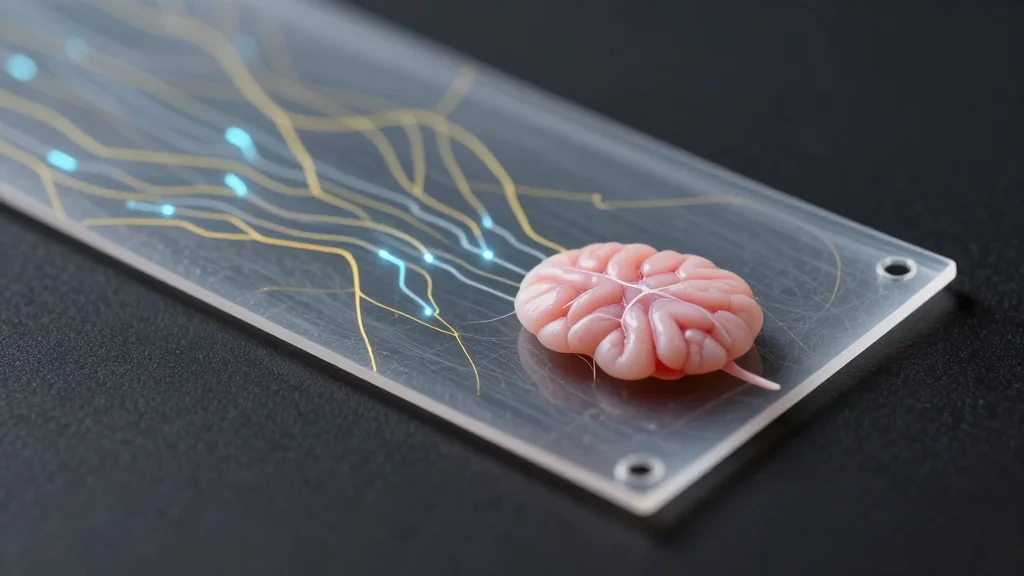
Northwestern Engineers Print Artificial Neurons That Talk to Real Brain Cells

Why It Matters
The ability to print functional artificial neurons that can directly stimulate living brain cells bridges a critical divide between nanofabrication and neurobiology. By demonstrating realistic, biocompatible signaling, the work paves the way for implantable devices that could treat neurological disorders, restore lost senses, and enable seamless brain‑machine communication. In parallel, the energy‑efficient signaling model offers a template for neuromorphic chips that could dramatically cut the power demands of AI training and inference, addressing a growing sustainability challenge in the tech industry. Beyond medical applications, the flexible printing platform could democratize access to advanced neuro‑electronics, allowing smaller research labs and startups to prototype custom neuron arrays without the high costs associated with traditional semiconductor fabs. This could accelerate innovation across the nanotech ecosystem, fostering new business models centered on personalized neuroprosthetics and brain‑inspired computing hardware.
Key Takeaways
- •Northwestern engineers printed flexible artificial neurons using aerosol‑jet printing on polymer substrates.
- •The devices generated realistic electrical spikes that triggered responses in mouse brain slices.
- •Study published in Nature Nanotechnology demonstrates first functional bio‑electronic integration of printed neuron arrays.
- •Researchers argue the approach could enable low‑power, brain‑like computing and next‑generation neuroprosthetics.
- •Future work includes in‑vivo testing and integration with wireless modules for fully implantable brain‑machine interfaces.
Pulse Analysis
The printed neuron breakthrough signals a paradigm shift in how nanotechnology can be leveraged for neuroengineering. Historically, the field has been constrained by the rigidity and scalability limits of silicon, forcing designers to compromise between device density and biocompatibility. By moving to a printable, polymer‑based platform, Northwestern sidesteps these trade‑offs, offering a manufacturing route that is both cost‑effective and adaptable to the brain’s soft, three‑dimensional architecture. This could catalyze a wave of start‑ups focused on custom neuro‑interfaces, much as the desktop 3‑D printing revolution spawned new business models in rapid prototyping.
From a market perspective, the convergence of AI’s soaring energy consumption and the brain’s unparalleled efficiency creates a compelling value proposition for neuromorphic hardware. Companies such as Intel and IBM have invested heavily in brain‑inspired chips, yet they remain tethered to conventional silicon processes. The printed neuron approach could provide a complementary pathway, delivering analog signal fidelity and low‑power operation that digital architectures struggle to match. Investors may begin to view nanofabrication capabilities as a strategic asset for AI hardware, potentially redirecting capital toward firms that can scale flexible printing technologies.
Looking forward, the key challenge will be translating ex‑vivo success to chronic, in‑vivo applications. Long‑term biostability, immune response, and reliable wireless power delivery are hurdles that must be cleared before clinical adoption. Nonetheless, the study establishes a proof‑of‑concept that the nanotech community can build upon, suggesting that within the next five years we could see the first generation of printed neuroprosthetic implants entering human trials, reshaping both medical treatment and the architecture of future AI systems.
Northwestern Engineers Print Artificial Neurons That Talk to Real Brain Cells
Comments
Want to join the conversation?
Loading comments...