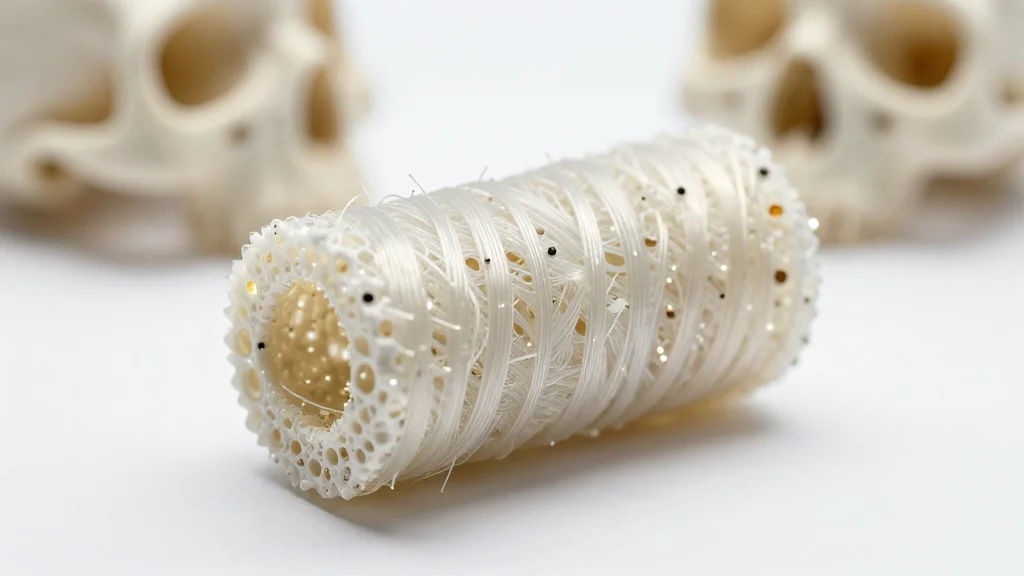
Oriented Nano‐Homogeneous Biomimetic Scaffolds Regulate Cell Alignment and Promote Endogenous Bone Regeneration
Why It Matters
By integrating mechanical reinforcement, antibacterial function, and bone‑mimicking architecture, the scaffold tackles three core limitations of current bone tissue engineering solutions, accelerating the path toward clinically viable regenerative implants.
Key Takeaways
- •Directional freeze‑casting creates radially aligned channels mimicking native bone
- •Tunicate nanocellulose ensures uniform carbon nanotube dispersion in chitosan
- •Photothermal carbon nanotubes achieve >98% antibacterial kill rate
- •Oriented scaffold raises bone mineral density to 0.688 g/cm³ in rats
- •Enhanced cell alignment accelerates osteogenic activity versus random scaffolds
Pulse Analysis
Bone tissue engineering has long wrestled with the trade‑off between structural strength and biological activity. Conventional organic‑inorganic composites often feature random porosity, limiting cell guidance and nutrient flow. Recent advances in directional freeze‑casting enable the fabrication of scaffolds with anisotropic channels that echo the hierarchical organization of native bone, providing a conduit for vascular infiltration and aligned osteoblast migration. This biomimetic architecture sets a new benchmark for osteoconductivity while preserving the flexibility needed for surgical handling.
The scaffold’s material palette is equally innovative. Tunicate nanocellulose acts as a natural dispersant, preventing carbon nanotube agglomeration within a chitosan matrix and delivering uniform mechanical reinforcement. In situ mineralization deposits hydroxyapatite uniformly across the scaffold, boosting bioactivity and mimicking the mineral phase of bone. Crucially, the embedded carbon nanotubes confer a photothermal response that eradicates over 98% of Staphylococcus aureus upon near‑infrared illumination, addressing postoperative infection risks without antibiotics. This multifunctional synergy of reinforcement, bioactivity, and antibacterial action represents a holistic solution rarely achieved in a single construct.
In vivo validation underscores the platform’s promise. Rats implanted with the oriented scaffold exhibited a bone mineral density of 0.688 g/cm³ after three months—significantly higher than control groups with isotropic scaffolds. The anisotropic channels facilitated superior cell alignment and accelerated osteogenic signaling, translating into faster defect closure. For clinicians, such outcomes suggest reduced healing times and lower complication rates. Looking ahead, scaling the freeze‑casting process and integrating patient‑specific imaging could enable custom‑fit, off‑the‑shelf implants, positioning this technology at the forefront of next‑generation regenerative medicine.
Oriented Nano‐Homogeneous Biomimetic Scaffolds Regulate Cell Alignment and Promote Endogenous Bone Regeneration
Comments
Want to join the conversation?
Loading comments...