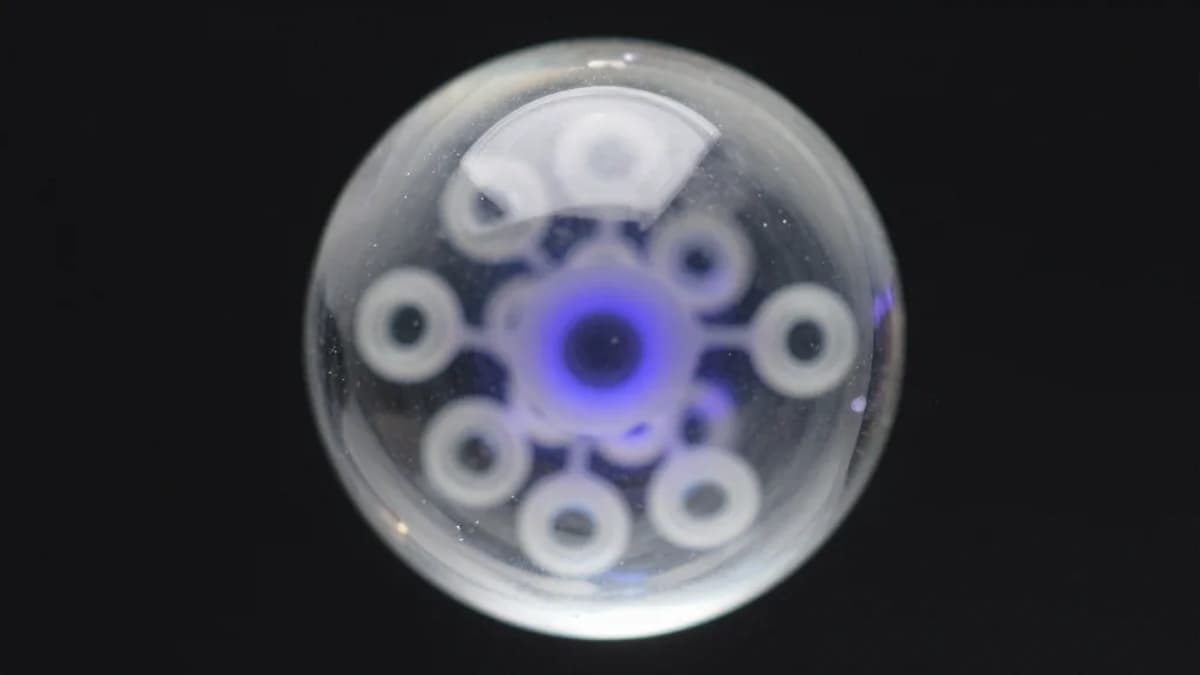
Photoacid‐Fueled Nanopropeller for the Controllable Motion of One‐Hole Colloidal Motors with On‐Board ATP Supply
•January 27, 2026
0
Companies Mentioned

Why It Matters
The technology demonstrates a self‑contained nanobot that converts light into both propulsion and chemical energy, opening pathways for targeted biomedical interventions without external fuels.
Key Takeaways
- •Light triggers proton release via photoacid isomerization
- •Proton motive force drives ATPase rotation in silica capsule
- •Rotating ATPases generate self-diffusiophoretic thrust
- •Motors achieve 3 µm/s speed and synthesize ATP
- •Exhibit chemotaxis toward ADP/OH⁻ gradients
Pulse Analysis
The quest for autonomous nanomachines has accelerated as researchers seek to mimic the efficiency of biological motors. Conventional synthetic swimmers rely on external fuels or magnetic fields, limiting their applicability inside living systems. The recent development of a photoacid‑fueled nanopropeller bridges this gap by embedding a light‑responsive proton source directly within a colloidal carrier. By co‑assembling chloroplast‑derived F₁F₀‑ATP synthase onto a single‑hole silica capsule, the platform converts ultraviolet illumination into a localized proton gradient, a strategy that mirrors natural photosynthetic energy conversion. Such a self‑contained energy module reduces reliance on external chemical fuels, enhancing biocompatibility.
Upon UV exposure, the encapsulated 2‑nitrobenzaldehyde undergoes photo‑isomerization, releasing protons that traverse the 200 nm aperture and establish a transmembrane proton motive force. This electrochemical potential drives continuous, unidirectional rotation of the surface‑bound ATPases, which in turn creates an imbalance of self‑diffusiophoretic forces. The resulting thrust propels the particle at an average velocity of 3.05 µm s⁻¹, while the rotating enzymes simultaneously synthesize ATP from ADP and inorganic phosphate, releasing usable chemical energy into the surrounding medium. The simultaneous ATP output also creates a local energy reservoir that could power downstream nanodevices.
The integration of locomotion and on‑board energy production opens new avenues for nanorobotics in medicine and synthetic biology. Positive chemotaxis toward ADP/OH⁻ gradients demonstrates the ability to navigate chemical landscapes, a prerequisite for targeted drug delivery or tissue engineering scaffolds. Moreover, the light‑controlled actuation offers spatial and temporal precision without invasive reagents. Future work will likely focus on scaling the system, extending wavelength responsiveness, and coupling additional functional modules such as sensing or cargo release. By leveraging biodegradable silica shells, the design aligns with regulatory expectations for clinical translation.
Photoacid‐Fueled Nanopropeller for the Controllable Motion of One‐Hole Colloidal Motors with On‐Board ATP Supply
0
Comments
Want to join the conversation?
Loading comments...