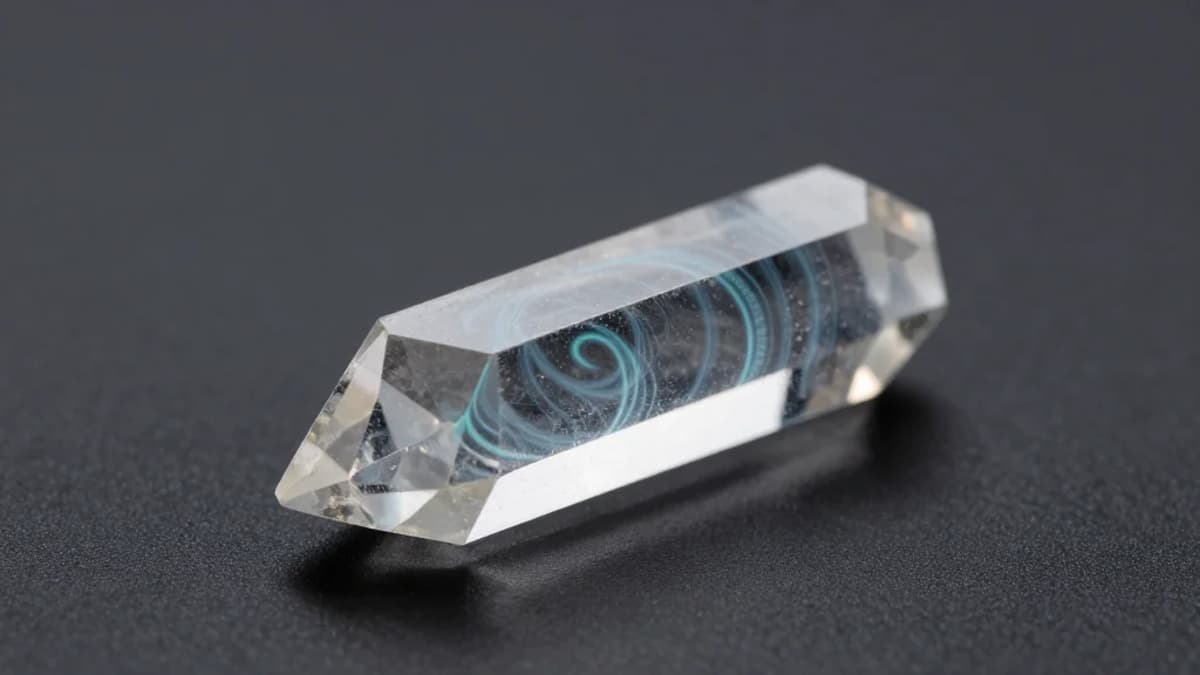
Physicists Open Door to Future, Hyper-Efficient Orbitronic Devices
•February 24, 2026
0
Why It Matters
The discovery paves the way for low‑cost, lightweight orbitronic components, reducing dependence on critical magnetic metals and enabling greener, faster computing architectures.
Key Takeaways
- •Chiral phonons generate orbital angular momentum in non‑magnetic quartz
- •No magnets or batteries required for orbital current generation
- •Method uses abundant, inexpensive materials versus critical transition metals
- •Demonstrated orbital Seebeck effect via thin tungsten/titanium layers
- •Technique applicable to tellurium, selenium, perovskites for scalable orbitronics
Pulse Analysis
Orbitronics, the emerging cousin of spintronics, seeks to harness the electron’s orbital motion for information storage and logic. Traditional schemes rely on transition‑metal ferromagnets, which are heavy, costly, and classified as critical raw materials. By exploiting chiral phonons—twisted lattice vibrations that carry intrinsic angular momentum—researchers have opened a magnetic‑free pathway to generate orbital currents. This sidesteps the need for external magnetic fields or voltage bias, dramatically simplifying device stacks and lowering material overhead.
The experimental breakthrough centers on α‑quartz, a naturally chiral crystal whose atomic helices produce right‑ or left‑handed phonon modes. When a modest magnetic field aligns these modes, the collective vibration transfers its angular momentum to nearby electrons, producing a measurable orbital Seebeck voltage across deposited tungsten and titanium films. The effect was captured at the National High Magnetic Field Lab using laser‑based spectroscopy, confirming that non‑magnetic quartz can exhibit a substantial internal magnetic response through its phonons. This proof‑of‑concept validates the orbital Seebeck effect as a robust, reproducible phenomenon.
Industry implications are significant. Eliminating rare‑earth magnets and heavy metals reduces supply‑chain risk and enables thinner, lighter components for next‑generation processors and sensors. The methodology is compatible with other chiral semiconductors such as tellurium, selenium, and hybrid perovskites, suggesting a versatile materials platform. As the semiconductor ecosystem pushes toward terabit‑scale data throughput, orbitronics powered by chiral phonons could deliver higher efficiency and lower energy consumption, positioning it as a strategic technology for sustainable computing growth.
Physicists open door to future, hyper-efficient orbitronic devices
0
Comments
Want to join the conversation?
Loading comments...