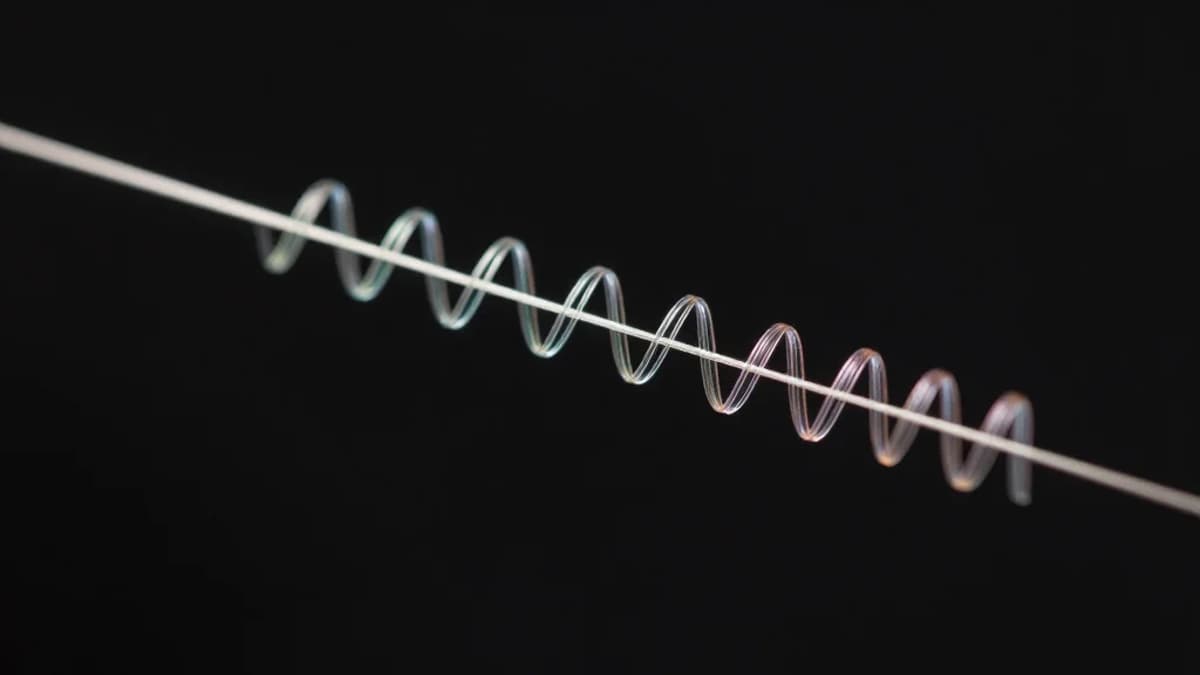
Poking a Nanostring: Scientists Uncover Energy Cascades in Tiny Resonators
•March 4, 2026
0
Why It Matters
The ability to generate multiple resonant modes within a single nanostring dramatically expands sensing bandwidth and reduces system complexity, positioning nanomechanical devices for next‑generation detection technologies.
Key Takeaways
- •Nanostring transfers energy from first to higher modes.
- •Cascade observed up to fifth vibrational mode.
- •Soft‑clamping enables internal energy redistribution.
- •Multi‑mode operation expands sensing channels per device.
- •Potential to replace multiple resonators with single nanostring.
Pulse Analysis
Nanomechanical resonators have long been prized for their high quality factors and minute mass, making them ideal for detecting forces, masses, and temperature shifts at the nanoscale. However, conventional designs typically isolate a single vibrational mode to avoid cross‑talk, limiting the amount of information a single device can extract. Recent advances in material engineering and phononic band‑gap structures have begun to challenge this paradigm, suggesting that controlled mode coupling could unlock richer signal landscapes without sacrificing sensitivity.
The Delft team’s breakthrough hinges on a soft‑clamping technique that relaxes the boundary conditions of a hundred‑nanometer‑thin string. By attaching the string to a chip that supplies a precise actuation frequency, the researchers observed energy leaking from the driven first mode into successive higher modes, creating a cascade that spans five distinct frequencies. This internal redistribution occurs without significant external damping, a feat made possible by tailoring the string’s tension and geometry to support coherent modal interactions. The experimental verification, published in Physical Review Letters, marks the first observation of such a high‑order cascade in a nanomechanical system.
From a commercial perspective, the multi‑mode cascade offers a compact pathway to multiplexed sensing. Each activated mode acts as an independent transduction channel, allowing a single nanostring to monitor multiple physical parameters or to improve detection limits through mode‑specific amplification. Industries ranging from biomedical diagnostics to environmental monitoring could benefit from reduced device footprints and lower fabrication costs. Future research will likely explore integration with CMOS‑compatible platforms, scalability of soft‑clamping architectures, and algorithmic decoding of complex modal spectra, positioning this technology at the forefront of next‑generation sensor design.
Poking a nanostring: Scientists uncover energy cascades in tiny resonators
0
Comments
Want to join the conversation?
Loading comments...