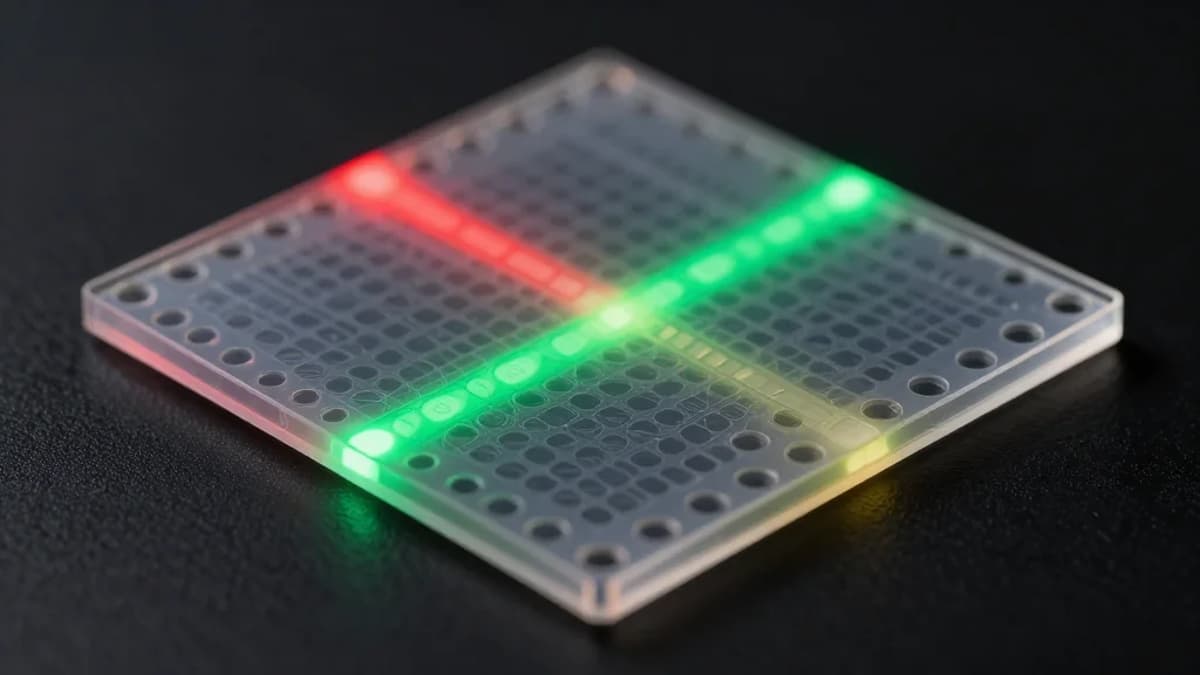
Polarization‐Dependent Elliptical and Rectangular Mie Voids
•February 16, 2026
0
Why It Matters
Polarization‑selective resonances enable multifunctional photonic components without additional layers, accelerating compact device design. The approach offers a low‑loss, fabrication‑friendly route to advanced metasurfaces and display technologies.
Key Takeaways
- •Anisotropic voids enable polarization-selective resonances
- •Elliptical/rectangular shapes tune resonance wavelengths
- •Demonstrated nanoscale color printing via polarization control
- •Platform supports geometric-phase metasurfaces and photonic devices
Pulse Analysis
The concept of Mie resonances traditionally relies on high‑index particles that trap light. Recent work flips this paradigm by using low‑index voids embedded in a high‑index matrix, allowing light to be confined in air at visible and ultraviolet frequencies. Introducing anisotropy—through elliptical or rectangular cross‑sections—adds a new degree of freedom: the resonant response becomes strongly dependent on the incident polarization. This shift expands the design toolbox for nanophotonic engineers seeking compact, wavelength‑scale elements that can be reconfigured simply by rotating the polarization state. Such polarization agility also simplifies device integration across diverse platforms.
The study systematically maps how void geometry influences resonance peaks. Elliptical voids exhibit distinct longitudinal and transverse modes, while rectangular voids produce sharper, polarization‑selective spectral features. By aligning the major axis with the electric field, researchers achieve controlled spectral shifts, enabling precise color generation at the nanoscale. Demonstrations of polarization‑dependent color printing illustrate that a single pattern can display multiple hues when illuminated with orthogonal polarizations, a capability that could replace multi‑layer lithography in high‑resolution displays and security markings. The technique requires only a single lithographic step, reducing fabrication complexity.
These anisotropic Mie voids open pathways for next‑generation metasurfaces that exploit geometric phase and polarization multiplexing. Integrating them with existing dielectric nano‑antennas could yield flat lenses, holograms, and beam‑steering devices that adapt in real time without mechanical parts. Moreover, the low‑loss air core promises higher efficiency than metal‑based counterparts, making the approach attractive for consumer optics, augmented‑reality headsets, and optical communication components. As the industry pushes toward ever‑smaller, multifunctional photonic chips, polarization‑dependent void resonators are poised to become a cornerstone technology. Early prototypes already demonstrate sub‑percent efficiency losses, underscoring commercial viability.
Polarization‐Dependent Elliptical and Rectangular Mie Voids
0
Comments
Want to join the conversation?
Loading comments...