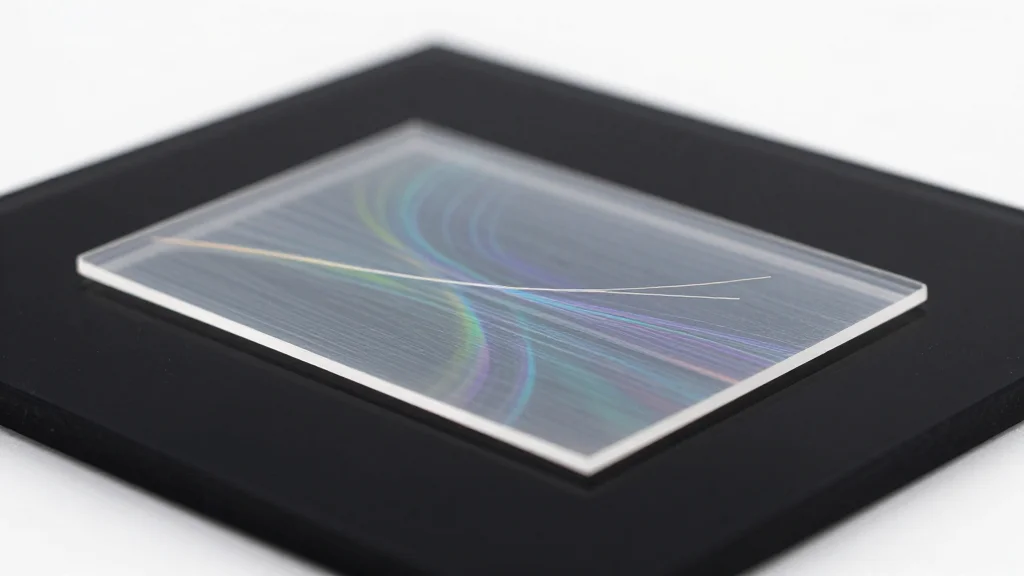
Polish Researchers Trap Infrared Light in 40‑nm Layer, 1,000× Thinner Than Hair

Why It Matters
The ability to trap light in a layer thinner than a thousandth of a human hair reshapes the fundamental limits of nanophotonics. By breaking the conventional wavelength‑size barrier, the MoSe₂ grating could accelerate the transition from electronic to photonic computing, where data moves at the speed of light with minimal heat generation. Moreover, the 1,500‑fold boost in third‑harmonic generation opens new avenues for on‑chip frequency conversion, a critical function for quantum communication and spectroscopy. Beyond pure performance, the scalable MBE fabrication aligns the breakthrough with existing semiconductor manufacturing ecosystems, lowering the cost and time required to bring ultra‑thin photonic components to market. If adopted widely, this technology could lead to smaller, faster optical transceivers in data centers, more sensitive biosensors, and compact lidar modules for autonomous vehicles, amplifying the economic impact of nanotech across multiple sectors.
Key Takeaways
- •Researchers trap infrared light in a 40 nm MoSe₂ layer—over 1,000 × thinner than hair
- •MoSe₂’s refractive index slows light ~4.5 ×, enabling sub‑wavelength confinement
- •Third‑harmonic generation efficiency improves >1,500 × versus flat MoSe₂
- •Molecular beam epitaxy allows wafer‑scale, uniform film production
- •Potential to shrink photonic chips by up to tenfold, boosting data‑center efficiency
Pulse Analysis
The Polish team's MoSe₂ grating tackles a long‑standing bottleneck in nanophotonics: the inability to confine light in structures smaller than its own wavelength without incurring prohibitive losses. By exploiting a material with a refractive index that dramatically slows photons, the researchers have effectively created a ‘slow‑light’ medium that compensates for the reduced physical dimensions. This mirrors the early days of silicon photonics, where high‑index contrast waveguides enabled tight bends; however, MoSe₂ pushes the concept into a regime previously thought unattainable.
From a market perspective, the breakthrough dovetails with the data‑center industry's push for optical interconnects that can keep pace with exascale computing demands. Current silicon‑based modulators occupy tens of micrometres; a ten‑fold reduction in footprint could translate into billions of dollars in capex savings as chip real‑estate becomes a premium commodity. Moreover, the 1,500‑fold increase in third‑harmonic generation could make on‑chip frequency conversion a standard feature, eliminating the need for bulky external nonlinear crystals.
Looking ahead, the key challenge will be translating laboratory‑scale performance into robust, manufacturable products. While MBE offers scalability, it is costlier than standard chemical vapor deposition, and yield control at volume will be critical. If the research team can demonstrate stable operation across temperature cycles and integrate the grating with existing CMOS photonics, the technology could become a cornerstone of the next generation of ultra‑compact, energy‑efficient optical systems.
Polish Researchers Trap Infrared Light in 40‑nm Layer, 1,000× Thinner Than Hair
Comments
Want to join the conversation?
Loading comments...