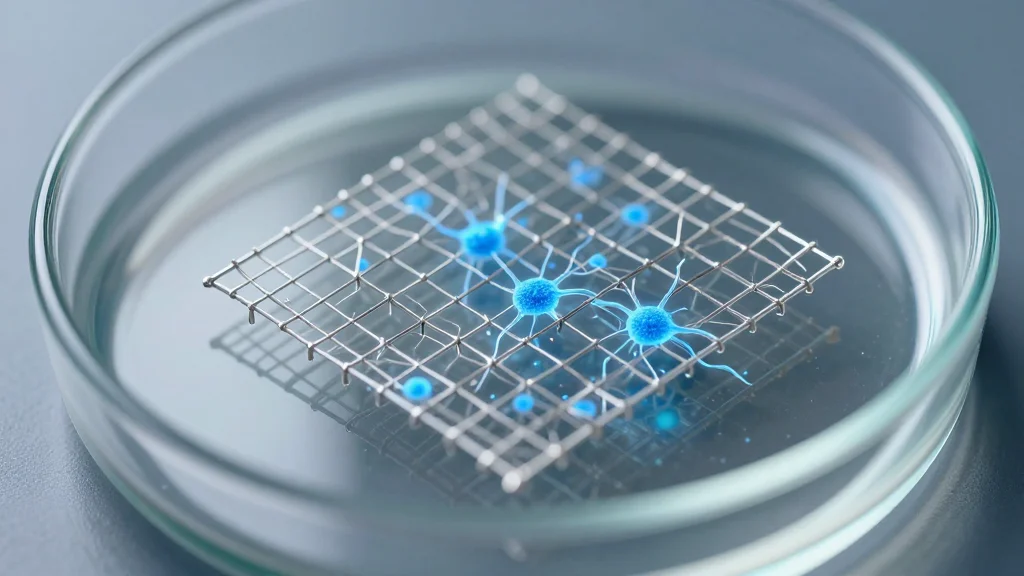
Princeton Team Demonstrates 3D Brain‑Electronic Hybrid Chip with 70K Neurons

Why It Matters
The Princeton hybrid chip bridges two traditionally separate fields—neuroscience and semiconductor engineering—showcasing how nanofabrication can create interfaces that treat living cells as active circuit elements. By proving that a dense neuronal network can be grown on a 3D electronic scaffold and used for pattern recognition, the work suggests a path toward ultra‑low‑power processors that mimic the brain's efficiency. This could influence AI hardware roadmaps, where energy consumption is a limiting factor, and inspire new research into bio‑compatible nanomaterials for medical diagnostics and brain‑machine interfaces. Beyond computing, the technology offers a novel platform for studying neural dynamics in a setting that combines precise electrical control with the biological realism of living tissue. Researchers could model disease states, test pharmacological interventions, or explore fundamental questions about learning and memory with unprecedented fidelity, accelerating both basic science and translational applications.
Key Takeaways
- •≈70,000 living neurons cultivated on a 3D metal‑wire mesh
- •Embedded electrodes enable direct recording and stimulation of neural activity
- •Six‑month trial demonstrated reliable detection of spatial and temporal signal patterns
- •Potential to cut AI hardware energy use by orders of magnitude
- •Future plans include scaling neuron count and integrating with neuromorphic processors
Pulse Analysis
The Princeton hybrid device arrives at a moment when the semiconductor industry is confronting the physical limits of transistor scaling. Companies such as Intel, IBM, and startups like Mythic have poured billions into neuromorphic and analog AI chips, yet power efficiency remains a bottleneck. By leveraging the innate low‑energy operation of biological neurons, the Princeton approach sidesteps the need for ever‑smaller transistors, instead using nanofabricated scaffolds to host living computation. This could redefine the competitive landscape: hardware firms may need to partner with bio‑engineers to co‑develop hybrid platforms, creating a new market segment that blends biotech licensing with semiconductor IP.
Historically, brain‑computer interfaces have focused on reading signals for prosthetics or therapeutic stimulation. The Princeton system flips the script, treating neurons as active processing units rather than passive data sources. If the scalability challenges—maintaining cell viability, ensuring reproducible fabrication, and integrating with existing digital architectures—are solved, we could see a wave of bio‑augmented processors targeting edge AI, where power budgets are tight. Venture capital is already tracking bio‑nanotech ventures, and a successful demonstration like this may catalyze a new funding round for companies that can commercialize living‑hardware hybrids.
However, the path to market is fraught with regulatory, ethical, and manufacturing hurdles. Long‑term stability of living tissue on chips, supply chain constraints for sterile nanofabrication, and public perception of ‘living computers’ will shape adoption timelines. In the short term, the most realistic impact will be in research tools—providing neuroscientists with unprecedented control over neural circuits. Over the next five years, we should watch for collaborations between Princeton and industry players, patents filed on the mesh architecture, and pilot projects that embed the hybrid device in neuromorphic testbeds. Those signals will indicate whether the technology moves from laboratory curiosity to a cornerstone of low‑energy AI hardware.
Princeton Team Demonstrates 3D Brain‑Electronic Hybrid Chip with 70K Neurons
Comments
Want to join the conversation?
Loading comments...