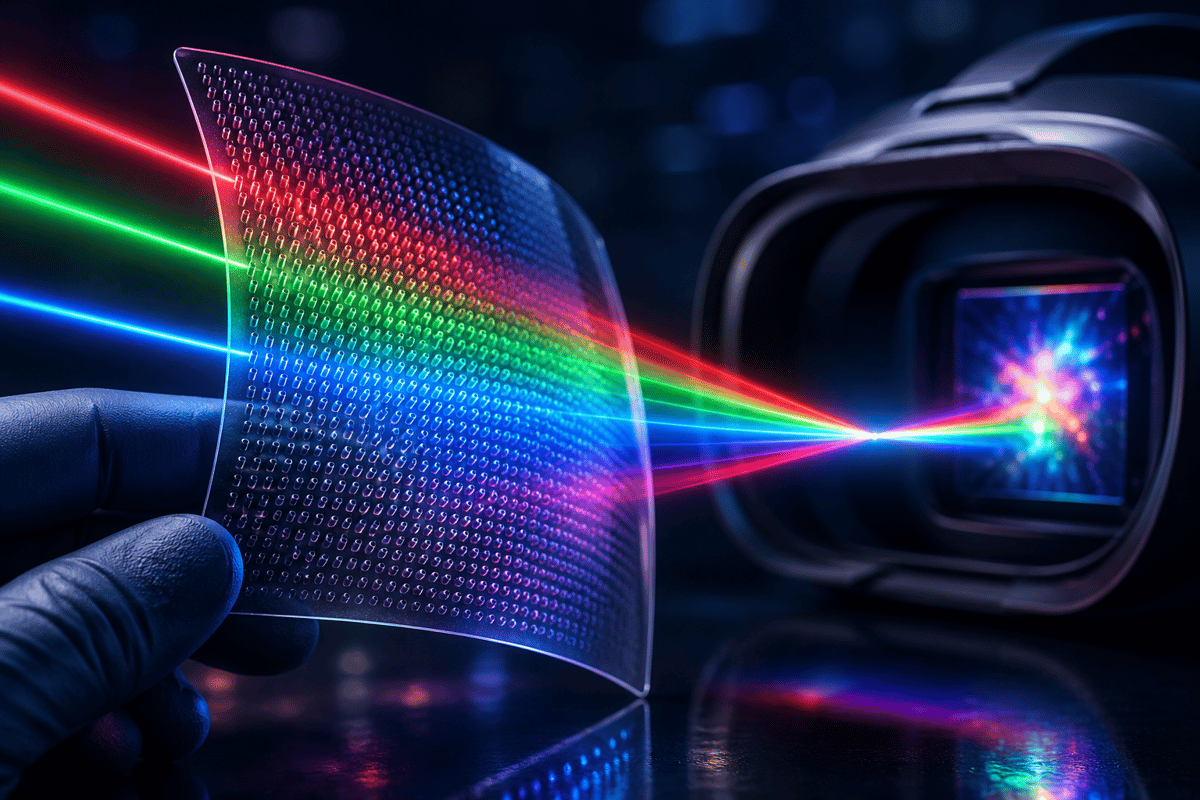
Printable 3D Metalenses Bring Full-Colour VR Displays Closer to Scalable Nanomanufacturing
Companies Mentioned

Why It Matters
The breakthrough dramatically lowers manufacturing complexity and cost of high‑performance meta‑optics, accelerating deployment of thin, lightweight VR/AR displays. It paves the way for large‑scale production of achromatic lenses previously limited to laboratory‑scale processes.
Key Takeaways
- •Grayscale EBL creates height‑encoded meta‑atoms for RGB phase control.
- •Nanoimprint replication yields flexible polymer metalenses on PET substrates.
- •Achromatic lenses focus 450‑635 nm light within 7 µm of design plane.
- •Strehl ratios 0.83‑0.86 meet diffraction‑limited criteria across visible spectrum.
- •Prototype VR system shows full‑color imaging with minimal chromatic blur.
Pulse Analysis
Meta‑optics have long promised ultra‑thin lenses that can replace bulky glass elements in consumer devices, but chromatic aberration has kept them from mainstream adoption. Conventional achromatic designs rely on multilayer stacks or high‑aspect‑ratio nanostructures, which demand costly alignment steps and low‑throughput fabrication. As a result, manufacturers have struggled to translate laboratory‑grade performance into volume‑ready components for virtual‑reality (VR) and augmented‑reality (AR) headsets.
The new approach leverages grayscale electron‑beam lithography to sculpt height‑encoded nano‑templates, adding a third design dimension to the meta‑atom library. By precisely controlling both diameter and height, engineers can tailor the phase response at red, green, and blue wavelengths simultaneously, eliminating the need for complex multilayer stacks. The templates are then replicated via nanoimprint lithography onto a UV‑curable resin laminated to a flexible PET film, creating polymer metalenses that are both lightweight and mechanically robust. Optical testing confirms diffraction‑limited performance with Strehl ratios exceeding 0.8 and focal spot alignment within 7 µm across the visible spectrum.
For the VR/AR market, this manufacturing breakthrough could be a game‑changer. The ability to produce high‑quality achromatic lenses at scale reduces component cost and enables slimmer, lighter headsets that deliver true full‑color imagery without the typical color fringing. As consumer demand for immersive experiences grows, manufacturers equipped with this nano‑template technology will be positioned to meet volume requirements while maintaining optical excellence, potentially accelerating the rollout of next‑generation wearable displays.
Printable 3D Metalenses Bring Full-Colour VR Displays Closer to Scalable Nanomanufacturing
Comments
Want to join the conversation?
Loading comments...