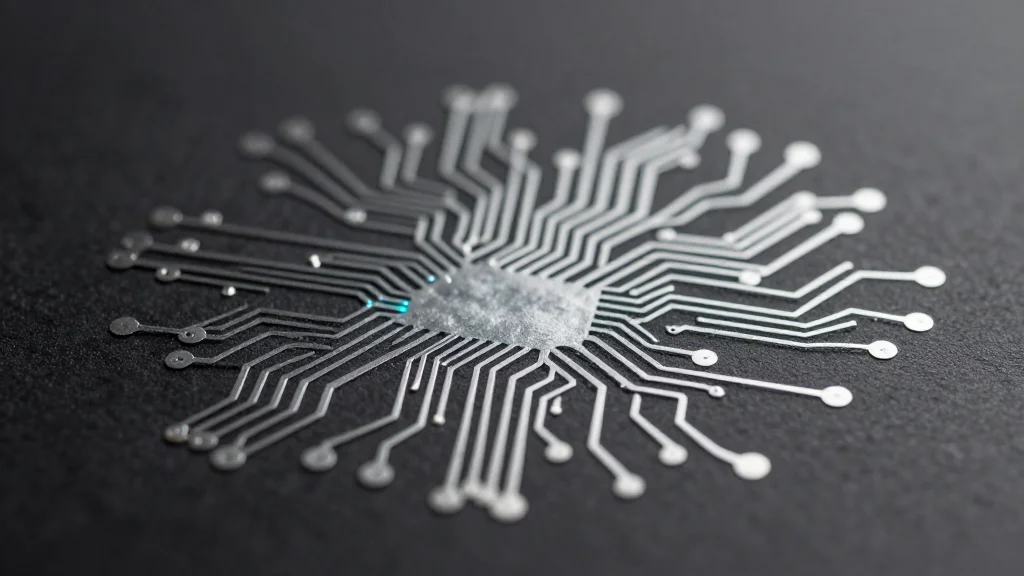
Printed Devices Turn Neuromorphic
Why It Matters
Matching physiological spiking timescales enables direct communication between silicon and neurons, shortening development cycles for brain‑computer interfaces. The printable, inexpensive fabrication could democratize bio‑hybrid technologies and spur new market opportunities.
Key Takeaways
- •Printed MoS₂ neuristors mimic biological spiking patterns.
- •Scalable ink‑jet printing creates nanosheet neural networks.
- •Devices operate on millisecond timescales matching neural firing.
- •Facilitates direct electrical coupling with living brain tissue.
- •Accelerates development of bio‑hybrid brain‑machine interfaces.
Pulse Analysis
The rise of printed electronics has opened a pathway to fabricate complex circuits without traditional lithography, leveraging materials like molybdenum disulfide that combine semiconducting behavior with mechanical flexibility. MoS₂ nanosheets can be dispersed into inks, enabling high‑resolution ink‑jet or aerosol jet printing onto diverse substrates. This manufacturing paradigm reduces material waste and allows large‑area production, crucial for scaling neuromorphic hardware that traditionally relies on costly, wafer‑based processes.
In the recent USC study, researchers printed interconnected MoS₂ nanosheet networks that function as artificial neurons, or neuristors. By engineering the sheet density and contact geometry, they achieved multi‑order spiking dynamics—sequences of voltage pulses that mirror the refractory periods and burst patterns of real neurons. Crucially, the spiking occurs on millisecond timescales, aligning with the natural firing rates of cortical cells. This temporal fidelity, combined with the ability to pattern devices directly onto flexible carriers, creates a practical interface for recording and stimulating living neural tissue.
The implications extend beyond academic curiosity. Brain‑machine interfaces (BMIs) demand biocompatible, low‑latency components that can be deployed at scale for therapeutic or augmentative applications. Printed MoS₂ neuristors could serve as the front‑end transducers in implantable or wearable BMI systems, offering a cost‑effective alternative to silicon‑based chips while preserving the speed needed for real‑time neural decoding. As the neurotechnology market projects multi‑billion‑dollar growth, such printable neuromorphic platforms may become a cornerstone for next‑generation bio‑hybrid devices, accelerating commercialization and expanding access to neural interfacing technologies.
Printed devices turn neuromorphic
Comments
Want to join the conversation?
Loading comments...