Researchers Separate Colloidal Particles According to Size and Guide Them on Different Paths
Key Takeaways
- •Magnetic checkerboard creates size‑dependent energy landscapes for colloids.
- •Uniform external field directs particles along diamond‑shaped contours.
- •Simultaneous S and L trajectories prove independent multi‑size control.
- •Method supports robust lab‑on‑chip and smart material production.
Pulse Analysis
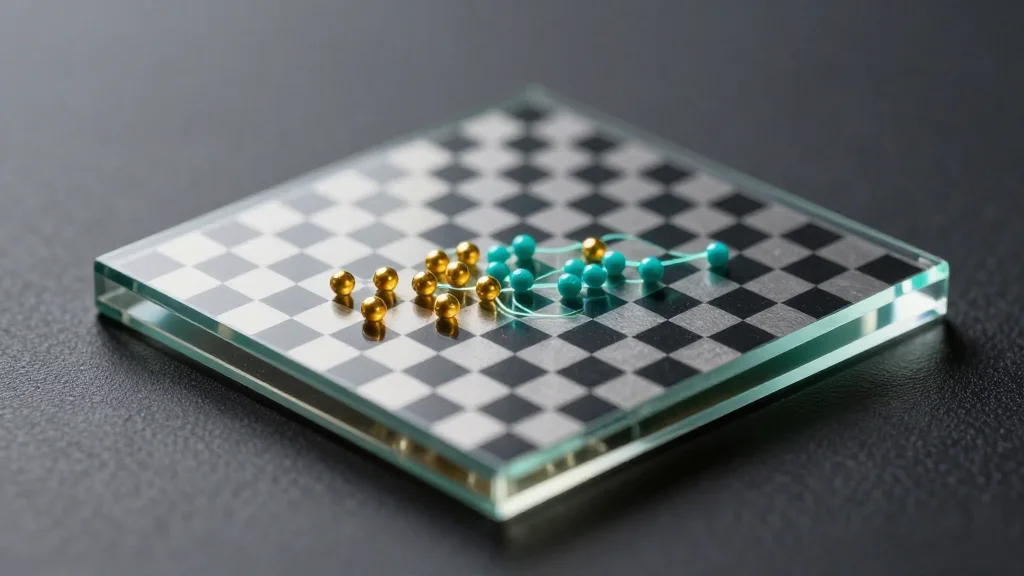
Colloidal particles—tiny solids suspended in fluid—are the workhorses of modern micro‑fabrication, drug‑targeting assays, and optical materials. Traditional magnetic steering relies on a uniform force field that moves all particles alike, forcing engineers to sort them mechanically before manipulation. The new approach, reported in Physical Review Letters, sidesteps that bottleneck by exploiting a patterned magnetic substrate that generates a size‑dependent energy landscape. By positioning the particles closer to the checkerboard‑like magnetic layer, the researchers amplify the differential response, turning particle diameter into a selectable control knob.
The core of the technique is a magnetic checkerboard whose alternating domains create diamond‑shaped contours when an external field is applied. Because the contours expand with particle size, a single field rotation can mobilize a large bead while leaving a smaller one untouched. The team demonstrated this by guiding two beads along separate paths that traced the letters “S” and “L” simultaneously, a motion that remains stable despite imperfections—a property known as topological protection. This programmable, multi‑size routing opens the door to arbitrarily complex trajectories on a single chip.
From a commercial perspective, the ability to sort and direct particles in situ could streamline lab‑on‑a‑chip platforms, reducing the need for external pumps or optical tweezers and cutting assay time. In materials science, the method enables the parallel assembly of photonic crystals and other nanostructures with precise size grading, potentially lowering production costs for optical sensors and quantum‑dot arrays. While scaling the magnetic pattern to wafer‑size and integrating it with existing microfluidic circuitry remain engineering challenges, the proof‑of‑concept suggests a versatile tool for next‑generation diagnostics and smart‑material manufacturing.
Researchers separate colloidal particles according to size and guide them on different paths
Comments
Want to join the conversation?