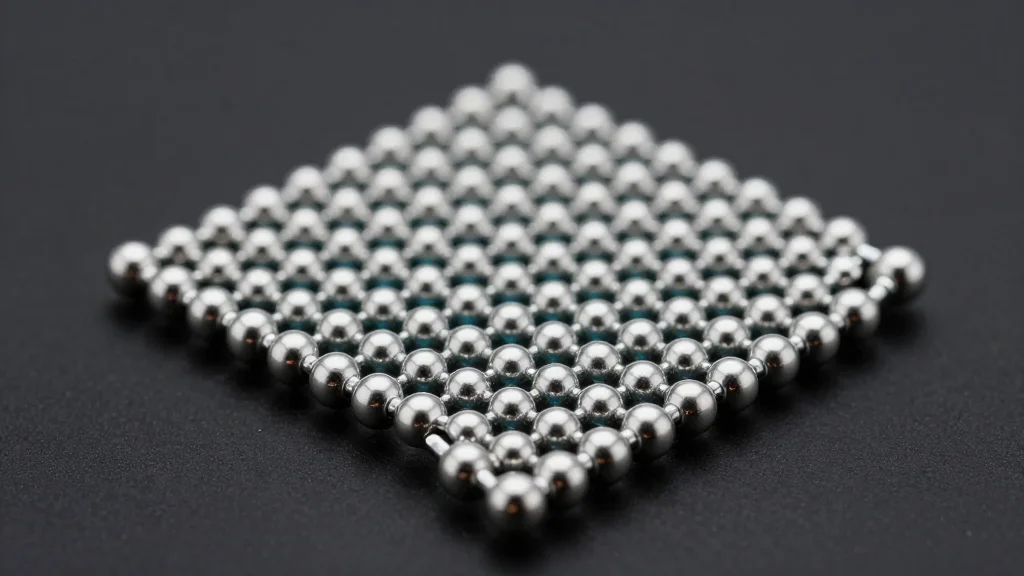
Researchers Stabilize Elusive Crystal Phase Using Silver Nanoparticles

Why It Matters
Stabilizing a transient crystal phase bridges a gap between theoretical predictions and experimental reality, giving scientists a tangible system to study phase‑transition dynamics at the nanoscale. This capability could reshape how researchers approach material discovery, moving from trial‑and‑error bulk synthesis to precise, programmable assembly of nanoscopic building blocks. For the quantum technology sector, the ability to tailor optical properties through crystal symmetry opens a new design dimension for qubits, single‑photon sources, and low‑loss waveguides. If the demonstrated optical behaviors can be integrated into scalable platforms, the breakthrough may accelerate the development of hardware that leverages quantum effects for computation and secure communication.
Key Takeaways
- •First experimental stabilization of a predicted in‑transition crystal phase using silver "mecon" nanoparticles
- •Researchers combined shape‑controlled synthesis, molecular coating, and self‑assembly to create ordered superlattices
- •Observed optical properties suggest potential applications in quantum computing and photonic devices
- •Study validates the Nishiyama‑Wassermann pathway for FCC‑to‑BCC transitions in metals
- •Provides a bottom‑up blueprint for accessing other elusive material phases
Pulse Analysis
The breakthrough reflects a broader shift toward atom‑by‑atom engineering in nanotechnology. Historically, phase‑transition research relied on high‑temperature bulk experiments that obscured transient states. By leveraging colloidal chemistry and computational modeling, Chen and colleagues have turned the assembly process into a controllable laboratory parameter, effectively turning a fleeting theoretical construct into a reproducible material.
From a market perspective, the ability to lock in specific crystal symmetries could spawn a niche of custom‑nanoparticle platforms targeting quantum hardware manufacturers. Companies developing photonic quantum processors are actively scouting materials that offer low decoherence and tunable emission spectra; a silver‑based superlattice with engineered optical modes fits that demand profile. If the synthesis can be scaled, we may see early-stage licensing deals or joint ventures between academic labs and quantum‑tech startups.
Looking ahead, the real test will be whether the observed quantum optical effects translate into device‑level performance gains. The research community will likely focus on measuring coherence times, integrating the superlattice with existing silicon photonics, and exploring other metals that could host similar intermediate phases. Success in these areas could redefine material discovery pipelines, making programmable nanostructures a standard tool rather than a laboratory curiosity.
Researchers Stabilize Elusive Crystal Phase Using Silver Nanoparticles
Comments
Want to join the conversation?
Loading comments...