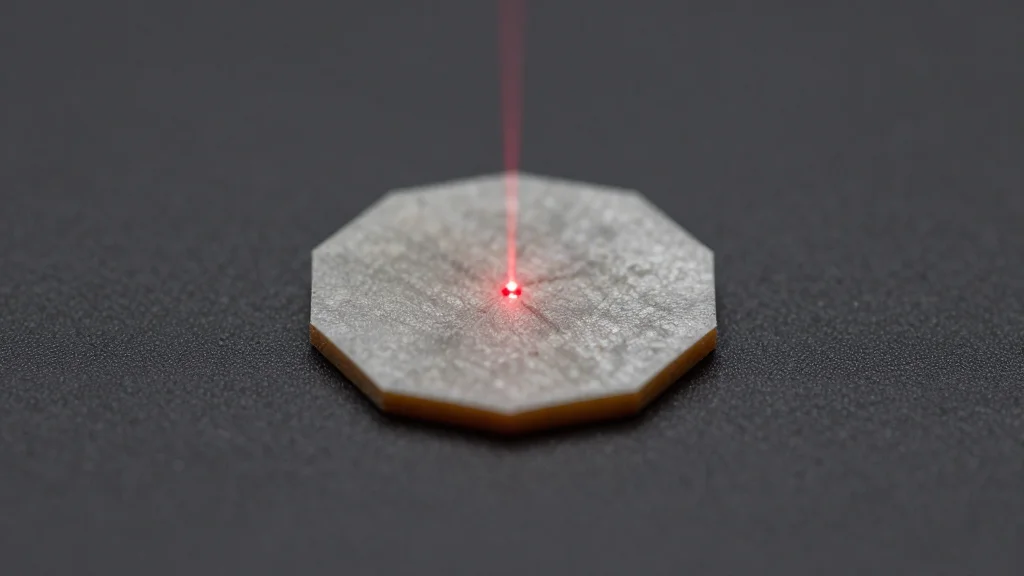
Revealing Intrinsic Functionalization, Structure, and Photo‐Thermal Oxidation in Hexagonal Antimonene (Small 25/2026)
Why It Matters
Stabilizing antimonene while enabling precise oxide interfaces removes a major barrier to its use in 2D semiconductor devices, expanding the material options beyond graphene.
Key Takeaways
- •Thiol groups protect antimonene core during laser heating
- •Raman thermometry links flake thickness to temperature rise
- •Photo‑thermal oxidation creates antimony‑oxide layers on surface
- •Controlled interfaces enable design of 2D heterostructures
- •Colloidal synthesis yields uniform hexagonal antimonene sheets
Pulse Analysis
The family of two‑dimensional (2D) crystals has expanded far beyond graphene, with antimonene—single‑layer antimony—emerging as a promising semiconductor due to its narrow bandgap and high carrier mobility. However, pristine antimonene is notoriously reactive, rapidly forming oxides that degrade electronic performance. In the latest Small article, Gonzalo Abellán’s team demonstrates that attaching thiol molecules to β‑antimonene hexagons during colloidal synthesis creates an intrinsic functionalization layer that shields the lattice while preserving its hexagonal symmetry. This strategy mirrors successful passivation techniques used in transition‑metal dichalcogenides, but uniquely leverages sulfur chemistry to stabilize a group‑15 element.
The researchers employed Raman thermometry to monitor temperature evolution under a focused laser probe, revealing a clear correlation between flake thickness and local heating. Thinner sheets exhibited higher temperature spikes, accelerating surface oxidation to antimony‑oxide, whereas the thiol‑capped regions limited oxidation to the outermost layers. By mapping Raman shifts across the crystal, the team quantified the onset of photo‑thermal oxidation and demonstrated that the underlying crystalline core remains intact. This dual‑character—protected core with a tunable oxide shell—offers a controllable platform for engineering antimony‑based heterojunctions.
From a commercial perspective, the ability to fabricate stable antimonene with precisely engineered oxide interfaces could accelerate the integration of 2D semiconductors into flexible electronics, photodetectors, and quantum‑capable devices. The colloidal route is scalable, compatible with roll‑to‑roll processing, and sidesteps the high‑vacuum requirements of epitaxial growth, lowering production costs. Moreover, the thiol‑mediated protection scheme may be adapted to other air‑sensitive 2D materials, broadening the materials toolbox for next‑generation nanoelectronics. As the industry seeks alternatives to silicon for ultra‑thin transistors, antimonene’s tunable band structure and now demonstrated stability position it as a strong contender.
Revealing Intrinsic Functionalization, Structure, and Photo‐Thermal Oxidation in Hexagonal Antimonene (Small 25/2026)
Comments
Want to join the conversation?
Loading comments...